

As Dhaka residents go about their regular hectic life, fatigue often sets in. This 400-year-old (some historians say older) city is dotted with historic places – fortresses, mansions and religious sites. A sightseeing tour of Dhaka with family or loved ones can give you some respite during the holidays. That being said, this article covers 10 such historic sites and landmarks in Dhaka city.
10 Historical Sites in and around Dhaka
Lalbagh Fort
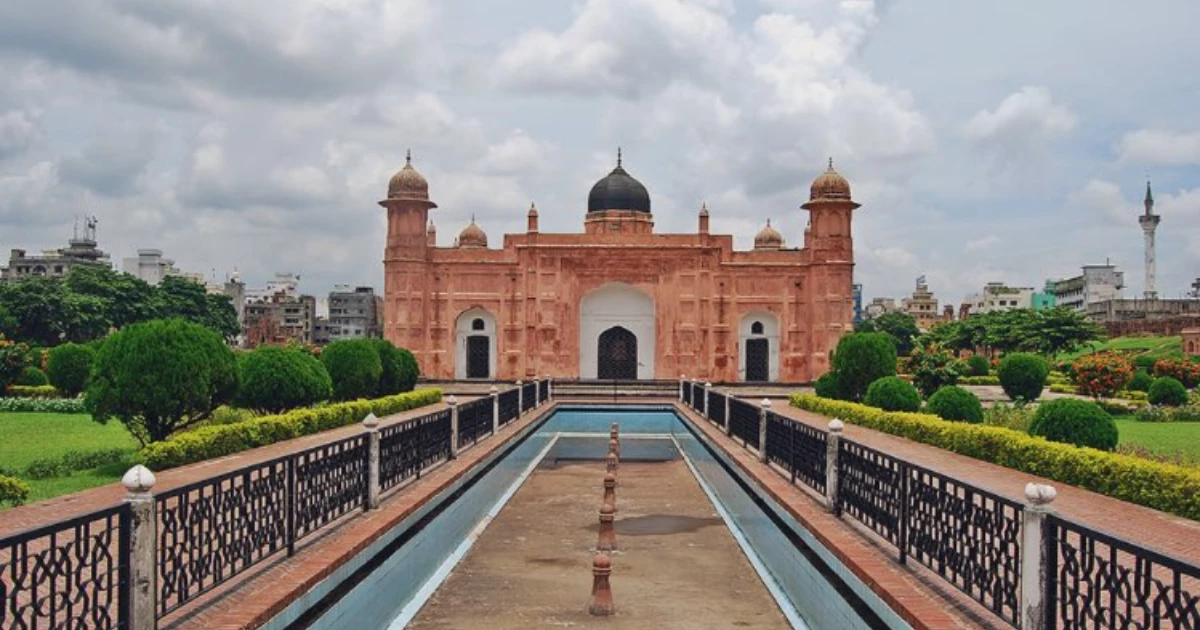
Lalbagh Fort is located in the Lalbagh area of Old Dhaka on the banks of the Buriganga river in the southwestern part of the capital Dhaka. Emperor Aurangzeb started the construction of the Lalbagh Fort in 1678 AD.
Currently, the residence and Durbar Hall of Subedar Shaista Khan, Lalbagh Fort, is used as a museum. Lalbagh Fort has three gates, but two of them are closed. As soon as you enter through the gate, the lovely garden cheers up your mind. If you go straight ahead along the entrance road, you can see the tomb built for the memory of Paribibi, the daughter of Shaesta Khan.
Furthermore, there are some more attractions worth visiting in this place. You can visit the Lalbagh Fort Mosque, beautiful fountains, and some more tombs and cannons used in war during that time.
Ahsan Mazil
Ahsan Manzil is located on the banks of the Buriganga River at Kumartoli in Old Dhaka. A century-old history of Dhaka is connected with Ahsan Manzil.
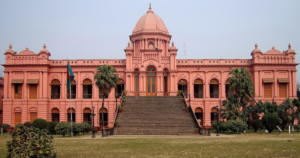
In the mid-eighteenth century, the then landlord Sheikh Inayet Ullah Ahsan built a palace called Rangmahal at the present site of Manzil. Later his son Sheikh Motiullah sold the Rangmahal to French merchants. Khwaja Alimullah, the father of Nawab Abdul Ghani, bought it in 1830. In 1859, Nawab Abdul Ghani started building a palace there. It took 13 long years to build the palace. He named it ‘Ahsan Manzil’ after his beloved son Khwaja Ahsanullah.
The biggest attraction of touring Ahsan Manzil is the collection of the museum. A total of 4077 artifacts are open for exhibition in 23 rooms of Ahsan Manzil. The total area of Ahsan Manzil is 5.65 acres.
Rose Garden Palace
Rose Garden Palace is located at Tikatuli in Dhaka. A Hindu landlord named Hrishikesh Das built it in the 19th century for entertainment. It was the birthplace of the Awami League. In 2018, the government bought it for Tk 331.70 crore from the present owner due to its archaeological value.
The ground floor of the house has a hall, eight rooms, and Corinthian columns. Upstairs there are five more rooms including another hall. Once upon a time, there was a fountain on the palace grounds. Though today the fountain is not functioning, traces of it can be seen. The rose garden for which the palace was named Rose Garden Palace is now extinct.
Panam Nagar, Sonargaon
Historical Panam Nagar is located at Sonargaon in Narayanganj district, near Dhaka. In the 15th century, Bengali ruler Isha Khan established the first capital of Bengal at Sonargaon. This city has been built over an area of about 20 square kilometers of Sonargaon.
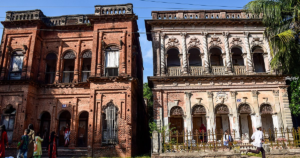
The structures of Panam Nagar were the dwelling place of the then elite citizens. The construction style of various buildings is unique in Panama City. There are about 52 buildings on both sides of the road that cuts through the heart of the city. There are 31 buildings on the north side of the main road and 21 on the south side. Some of these buildings have one floor, and some have two or three floors.
Panam Nagar was a well-known marketplace for Sonargaon’s fine arts, crafts, and muslin. This place provides witness to Sonargaon’s glorious history.
Star Mosque (Tara Masjid)
Tara Masjid is located on Abul Khairat Road in Armanitola. At the beginning of the 18th century, Mirza Ghulam, the then Landlord of Dhaka, built the mosque following the Mughal architectural style. The mosque is popularly known as Sitara Masjid or Mirza Ghulam Pir Masjid.
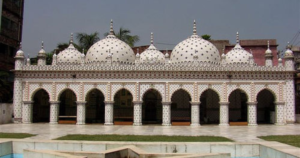
The mosque’s designs feature the star motif is particularly noteworthy. Because of this special design, the mosque came to be known as Tara Masjid.
Dhakeshwari Temple
This temple was built in the 12th century by King Ballal Sen of the Sen dynasty. During the liberation war of 1971, the Dhakeshwari temple was badly damaged by Pakistani forces. After the independence of Bangladesh, the temple was rebuilt according to the original design.
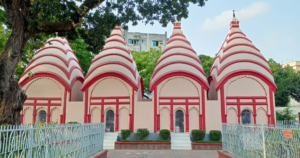
The mandapam of the temple has a standing altar of a metal-made idol of Goddess Durga. And every year Durga Puja is organized in Mahanagar Puja Mandap outside the main temple premises.
Swadhinata Stambha
It is a monument built to commemorate the liberation war of Bangladesh. It is located in the inner part of Suhrawardy Udyan in the heart of Dhaka city. The strong electric light rays emitted from it illuminate the surrounding sky.
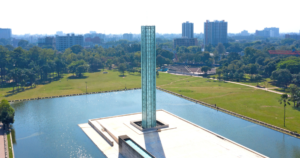
The Independence Pillar was designed by two architects, Marina Tabassum, and Kashef Mahboob Chowdhury of Urbana architecture firm. It is basically a glass tower. The structure of the tower is made of steel. The tower is 150 feet in height and 16 feet in width.
The Government of Bangladesh plans to construct the Independence Monument in Suhrawardy Udyan to commemorate various historical events, and it was one of the aspects of this combination.
Bara Katra
It was built on the banks of the Buriganga River in 1646 by the order of Shah Suja, son of the then Emperor Shahjahan. It was built by Abul Qasem, who was known as Mir-e-Imarat. Initially, this palace was supposed to be the residence of Shah Shuja, but later it was used as a guest house.
At one time, it was famous for its architectural beauty, but today its gate stands as a ruin. However, the government is taking steps to save this historic palace.
Ruplal House
Built by Armenians in the 19th century, the Ruplal house is located on Farashganj Road of Old Dhaka. It is one of the biggest houses in Dhaka. Ruplal House lost its appearance long ago. Now its existence is almost on the verge of extinction. The ground floor of the house houses various businesses and spice shops, and people live in different rooms above.
Hussaini Dalan
The nearly 300-year-old Hosseini Dalan, located on Nazimuddin Road in Old Dhaka, is a Shia shrine. It was built in the 17th century by Mughal Emperor Shah Jahan. The building was originally built to commemorate the martyrdom of Imam Hussain in Karbala.
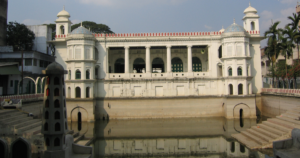
As soon as you enter through the entrance of this building, you will see a large garden, Shia graves, and main structures. You will see a large pond (built on 1.01 Bighas) at the back of the building. The total interior area of Hussaini Dalan is 9,380 square feet.
Final Words
While there are more historic palaces, religious sites, and forts located in Dhaka, These 10 are the top ones. You can visit these places on weekends or on holidays. However, before visiting, make sure you know the hours and days of operation.
