

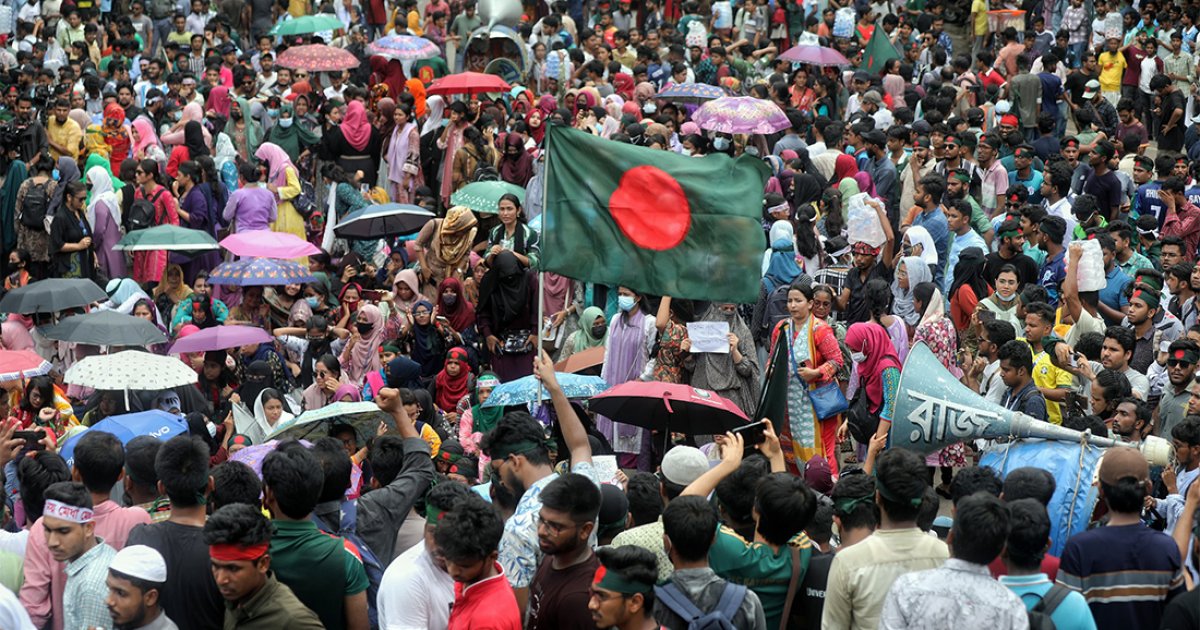
As dawn breaks on March 26, our nation’s sky is painted crimson and green. The flag flutters in the morning breeze as if breathing life into a sleeping world, the streets echo with the anthems of freedom, and the nation collectively looks back to a moment when everything changed.
Yet today, as we observe the 55th year of Bangladesh’s independence, something feels different. This is not the Bangladesh of years past. This is a nation reborn from its ashes, rebuilt by hands once thought unwilling or unable, and re-dreamed by a generation once deemed lost.
For decades, we celebrated this day with a ritualistic rhythm. We pledged our allegiance to the red-green flag, sang songs of liberation, and laid wreaths at the National Martyrs’ Monument. But deep down, many of us asked the same silent question: “What does independence mean to us now?”
We wondered if our forefathers’ sacrifices had led to the Bangladesh they had envisioned — a land free from oppression, inequality, and injustice. We wondered whether we were merely going through the motions on this hallowed day while the true spirit of liberation gathered dust in the corners of history.
But this year is different.
We are observing Independence Day in a new Bangladesh — one reshaped by the unforgettable July Movements of 2024. A Bangladesh where the collective heartbeat of a generation that once swore to leave now beats furiously with purpose and hope.
The country I stand in today is not the country I inherited — it is one we reclaimed, brick by brick, voice by voice. And the most powerful truth is this: I was there. We were there. We did not hear about it in whispered stories or from history books yet unwritten. We lived it. We changed it.
This year, the march pasts and patriotic songs are not just echoes of a glorious past but celebrations of a present we fought to reclaim. And it is in this context that we remember the legacy of March 26 and the men and women whose courage brought us here.
At the heart of Bangladesh’s story of independence stands Major Ziaur Rahman — a soldier whose voice crackled through the airwaves of the Kalurghat radio station on March 27 1971, declaring to the world that Bangladesh was free. But his journey, and what it represents, began long before that historic broadcast.
“This was the time for the final decision. In no more than a few seconds I said, we revolt,” Ziaur Rahman wrote in his 1972 article Birth of a Nation. And with that, he and his comrades of the 8th Battalion of the East Bengal Regiment ignited the flames of resistance. His declaration, “I, Major Zia, Provisional Commander-in-Chief of the Bangladesh Liberation Army, do hereby declare the independence of Bangladesh,” was more than just words; it was an act of defiance that unified a fragmented people under the banner of freedom.
Zia’s life had been marked by his deep hurt at the injustice meted out to Bengalis. As he himself reflected, “From that time, I carried a single dream deep in my heart — that if I ever got the chance, I would strike at the core of Pakistan’s existence.”
The bravery of Major Ziaur Rahman and his fellow fighters laid the foundation for a nation that now stands tall in their honour. His role as the Commander of BDF Sector 11 and later as the Brigade Commander of Z Force marked him not only as a warrior but as a visionary leader in Bangladesh’s most trying hours.
His sacrifices, and those of millions more, gave us this day — March 26 — as a reminder that freedom is never free. As Zia himself declared in the heat of battle, “We revolt,” so too did we revolt last July against oppression in a different age, for a different cause — but with the same undying spirit.
And that is why this year’s Independence Day feels unlike any other.
The July Revolution of 2024 was a generational awakening. For decades, we had been caricatured as a passive people — apathetic youth glued to our screens, too disillusioned or distracted to care.
We were told that the political arena was not ours to enter, that real change was impossible, and that our brightest future lay not within our motherland but in foreign lands. Yet when the iron grip of authoritarianism tightened its hold on our dreams, we stood up, shoulder to shoulder, in defiance. We said, “No more.” Just as our freedom fighters once took a stand against oppression, we too revolted.
I remember the fear in the early days of July. The fear of speaking out, of marching, of carrying placards that bore words we were once forbidden to utter. And then came the hope. The belief that change was not only possible — it was inevitable. We became the generation that redefined the meaning of liberation. Not in 1971, but in 2024. And so, this year’s March 26 is no longer just a date on a calendar. It is a symbol of our rebirth.
For those of us who marched last July, Independence Day feels personal. This time, when we stand for the national anthem, it is not just the song of our grandparents — it is ours. When we raise our flags, we do so with a deep, raw understanding of what it means to fight for a better tomorrow. We bear the scars of our struggle — friends lost to injustice; memories burned into our hearts — but we wear them as badges of honour.
I find myself thinking often of the faces we stood beside in the Shahbagh square. The students, the teachers, the doctors, and the ordinary men and women who became extraordinary through their courage.
We were all there — not as spectators, but as participants in writing Bangladesh’s next chapter. And as I look out at the crowds this Independence Day, I know that each person here carries their own story of resistance, their own memory of choosing courage over fear.
This is why this Independence Day is so different.
For the first time in decades, we are not only remembering the past — we are living its promise. The ideals of justice, equality, and democracy for which our freedom fighters and countless others fought in 1971 are not relics of history.
They are alive, breathing in the streets and squares, whispered in conversations among friends, and shouted in the slogans of protest. We are the children of those who sacrificed everything for freedom, and we are finally worthy of their legacy.
And yet, even as we celebrate, we must remember: That independence is not a finished story. It is a journey we continue every day. We won our political freedom in 1971. We reclaimed our democratic rights in 2024. And we will keep fighting — for economic equality, for justice, for a Bangladesh where no citizen is left behind. This year’s Independence Day is a checkpoint in that journey, a moment to gather strength for the road ahead.
As I stand here, watching the young and old alike raise their fists in solidarity, I feel a profound sense of hope. We are no longer bound by the apathy that once shackled us. We are awake. We are aware. And we are unyielding.
This is the dawn of a new Bangladesh.
And so, as the metaphorical fireworks light up the night sky, they are not just a spectacle — they are a promise. A promise that we, the people of Bangladesh, will never stop striving for the nation our ancestors dreamt of and that we are finally building with our own hands.
Independence was never about one day. It is about every day. And in this new Bangladesh, it is a future we are writing together.
H M Nazmul Alam is an Academic, Journalist, and Political Analyst.
He can be reached at [email protected].
