

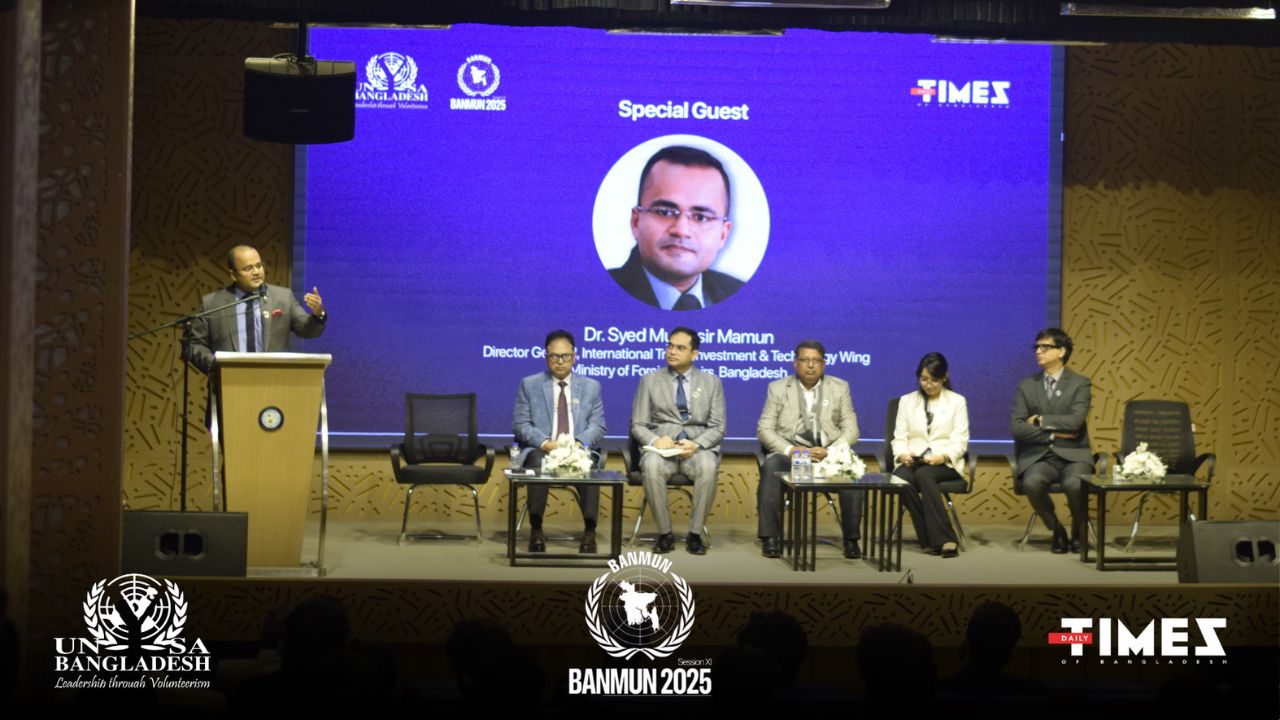
The Bangladesh Model United Nations (BANMUN)’25, organised by the United Nations Youth and Students Association of Bangladesh (UNYSAB) with TIMES of Bangladesh as the media partner, entered its second day at the American International University–Bangladesh (AIUB) with debates that grew sharper, more confrontational and strikingly reflective of real-world diplomatic fault lines.
Having opened on Friday under the theme “Just Energy Transition”, the conference quickly moved beyond ceremonial rhetoric into substantive political engagement, where questions of power, responsibility and accountability dominated committee rooms and press conferences alike.
The opening ceremony had already set a serious tone yesterday, underscoring that for climate-vulnerable countries like Bangladesh, issues such as displacement, energy justice and inequality are no longer abstract.

Day two of BANMUN’25 reinforced this urgency, as delegates grappled with the limits of international law, contradictions within state policies and the growing tension between sovereignty and global responsibility. Far from symbolic role-play, the sessions increasingly mirrored the confrontational and fragmented nature of contemporary global politics.
Several policy-focused interventions stood out across committees. In one session, an Irish national consultant urged Bangladesh to enforce stricter taxation mechanisms that would directly benefit rural women through strengthened local councils, highlighting fiscal policy as a tool of gender justice rather than mere revenue collection.
In contrast, Kazakhstan’s delegation drew attention for openly acknowledging that the country lacks specific human rights protections for indigenous peoples. An admission that exposed the gap between international commitments and domestic frameworks.
The same delegation went further, accusing the Democratic People’s Republic of Korea of fabricating a national culture, illustrating how cultural identity itself can become a site of geopolitical contestation.
Another sharp exchange unfolded when South Africa’s delegates accused the United States of violating Article 2 of the UN Charter through what it described as illegal cyber operations. Though climate and energy dominated the conference agenda, the accusation underscored how emerging technologies, security doctrines and sovereignty concerns are inseparable from debates on justice and accountability.
The United Nations Human Rights Council (UNHRC) emerged as one of the most intense arenas of the day. Chaired by a leadership team that included Co–Vice President Ayan Ahmed, the committee addressed the agenda of establishing a legal framework for the protection of climate-induced migrants. Ahmed highlighted a core challenge: international law still lacks a formal definition of climate-induced migrants, leaving millions displaced by floods, cyclones and sea-level rise without legal recognition.

While progress had been made, he acknowledged that research gaps and conceptual barriers, particularly around reconciling sovereignty with transnational responsibility continued to slow deliberations.
These tensions came sharply into focus during the subsequent press conference. India faced pointed questions over the contradiction between its global human rights advocacy and the absence of a comprehensive national legal framework for climate-induced migrants, despite hosting more than 140 million people in disaster-prone coastal regions.
The Indian delegate cited regional cooperation, resilient infrastructure and commitments under the Paris Agreement, while conceding that existing laws, including the 1951 Refugee Convention, remain inadequate for addressing environmental displacement.
Russia faced sustained scrutiny as well. Correspondents questioned Moscow on the absence of domestic and international protections for climate-induced migrants, particularly as the country warms at more than twice the global average. The Russian delegate emphasised the country’s relatively lower share of global emissions, its vast forest carbon sinks and Article 2.7 of the UN Charter on non-interference.
While stating that Russia did not wish to be an “obstacle,” the delegation stopped short of endorsing any binding international legal status for climate-induced migrants, reinforcing sovereignty as a recurring shield against accountability.
The sharpest confrontation of the day unfolded between the United States and Russia. Questioned about scaling back climate and humanitarian funding amid worsening displacement crises, the US delegate pointed to billions of dollars contributed over past decades and criticised other major emitters, particularly Russia and China, for insufficient action.
Delegates responded by highlighting the United States’ status as the largest historical emitter of greenhouse gases, responsible for roughly a quarter of cumulative emissions since the industrial era. References to oil production and military spending transformed the exchange into a broader indictment of historical responsibility, global inequality, and selective accountability.
Parallel debates played out in the UNESCO committee, which examined the intersection of renewable energy transitions and indigenous knowledge. Russia and China faced scrutiny over whether principles such as free, prior and informed consent were meaningfully enforced in large-scale projects affecting indigenous communities.
While both delegations emphasised development gains, critics noted the absence of enforceable rights-based guarantees. Mexico stood out by explicitly endorsing free, prior and informed consent as a substantive protection rather than a procedural formality.
By the end of the second day, BANMUN’25 had moved decisively beyond idealised visions of consensus-driven diplomacy. The debates revealed how climate-induced displacement and just energy transitions are deeply entangled with history, power and contested interpretations of international law.
Rather than weakening the conference, the confrontations underscored its relevance. As sessions continue, BANMUN’25 is emerging as a space where young delegates confront the uncomfortable realities of global governance. Learning that diplomacy is as much about navigating conflict as it is about drafting resolutions.
