

Bangladesh woke to a heavy silence on Tuesday morning. Khaleda Zia was gone.
At 6am, the former prime minister breathed her last at Evercare Hospital in Dhaka. She was 80. With her death, the country lost more than a political leader. It lost a defining chapter of its modern political history.
Khaleda Zia did not enter politics out of ambition. She stepped into it through grief. In 1981, after the assassination of President Ziaur Rahman, a young widow walked into politics holding her two sons. She had no political training. No blueprint. Only resolve.
From that moment, history pulled her forward. People trusted her. Power followed her. Resistance defined her.
She endured prison, illness and isolation. She faced sustained attacks on her character and politics. Yet she stood firm. Khaleda Zia became the first elected woman to lead Bangladesh. She challenged military rule when silence felt safer. For millions, she remained a symbol of defiance, reflecting their own struggles.
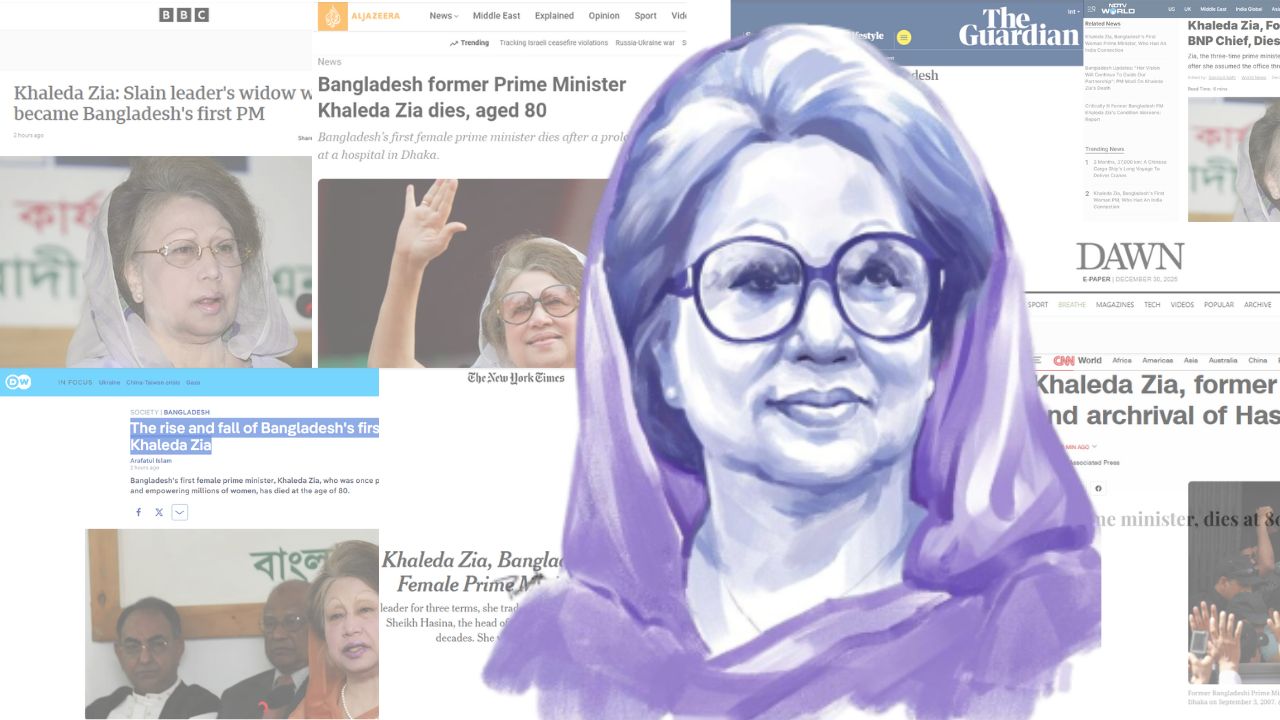
News of her death led headlines across international media as global media reflect on her life and legacy,
Most international outlets — including The New York Times, BBC, Hindustan Times, Reuters, Dawn, Geo News, US News and The Guardian — carried near-identical headlines “Khaleda Zia, Bangladesh’s First Female Prime Minister, Dies.”
In its report, New York Times addressed her as “A leader for three terms, she traded the country’s leadership with Sheikh Hasina, the head of another political dynasty, over decades.”

The report added “Ms Zia, the widow of the first of several military rulers in Bangladesh’s turbulent 50-year history as an independent nation, served two full terms and one shortened term as prime minister.”
It also noted “For much of the past three decades, she alternated as Bangladesh’s highest elected official with Sheikh Hasina, the daughter of the country’s slain founding president, who grew increasingly authoritarian until she was toppled following deadly protests last year.”
Toward the end of its report, The New York Times wrote “In her final decade of life, the ailing Ms Zia was hounded by her political rival, who kept her either in jail or under house arrest as court cases piled up against her.”
British broadcaster BBC published multiple reports on Khaleda Zia. In its death report, it mentioned her political planning and nomination ahead of Bangladesh’s upcoming election.

In a special feature titled “Khaleda Zia: Slain leader’s widow who became Bangladesh’s first PM,” BBC traced her rise from housewife to national leader. The report said “The daughter of a tea trader, she moved to what is now Bangladesh with her family after the partition of India. At the age of 15, she married Ziaur Rahman, then a young army officer.”
The BBC also detailed Ziaur Rahman’s political journey and noted “In the brutal world of Bangladeshi politics, she was accused of corruption and spent years in prison — but the charges were dropped after a 2024 uprising that saw her long-time rival, Sheikh Hasina, swept from power.”
Concluding its report, BBC wrote “She is survived by her elder son Tarique Rahman, who returned to Bangladesh in late December after spending years in exile in London, and who is widely seen as the frontrunner to become Bangladesh’s next leader. ‘Koko’, her younger son, died in 2015.”
Reports by AP and CNN explored different phases of her life under subheadings such as her resistance to military rule, rivalry with Sheikh Hasina, and health struggles that eventually overtook politics.

India’s NDTV opened its report saying “Bangladesh’s former Prime Minister Begum Khaleda Zia, who many believed would sweep elections next year to lead her country once again, has died after a prolonged illness while under treatment at Evercare Hospital in Dhaka.”

The report also noted that Indian Prime Minister Narendra Modi expressed grief over her death, quoting his post on X “Deeply saddened to learn about the passing away of former Prime Minister and BNP Chairperson Begum Khaleda Zia in Dhaka.”
NDTV detailed her early life, noting “Born in Jalpaiguri, British India (now West Bengal), in 1945, Khaleda’s family moved to Dinajpur, East Bengal (now Bangladesh), after the partition in 1947. Her father, Iskandar Mazumder, was a businessman, and her mother, Tayeba Mazumder, was a housewife.”
It also recalled her brief political cooperation with Sheikh Hasina during the 1990 uprising that toppled military ruler Hossain Mohammad Ershad, adding “But Zia and Hasina’s cooperation did not last long. Their bitter rivalry would lead to the two being dubbed ‘the battling Begums’.”
Hindustan Times ran multiple stories, including “Bangladesh’s first female PM Khaleda Zia dies at 80” and “Widowed by a coup, she went on to rule Bangladesh twice.”

The report mentions “Her principal political rival through much of her career was Sheikh Hasina, leader of the Awami League. The two women dominated Bangladesh’s politics for decades, with their rivalry shaping elections, governments, and street politics alike.”
Reuters reported “The BNP is seen as the frontrunner to win the parliamentary election slated to take place in February.”
It added that her son and party’s acting chairman, Tarique Rahman, returned to Bangladesh last week after nearly 17 years in self-exile and is widely viewed as a strong prime ministerial contender.
Reuters report described the Hsian Khaleda dimensions very interestingly. “Supporters saw her as polite and traditional yet quietly stylish, someone who chose her words carefully. But they also viewed her as a bold, uncompromising leader when it came to defending her party and confronting her rivals. Hasina, by contrast, was far more outspoken and assertive. Their opposite personalities helped fuel the rivalry that dominated Bangladesh’s politics for decades” it describes.

Pakistan’s Dawn referred to Khaleda Zia as a “committed friend to Pakistan,” while Geo News opened its report by highlighting her decades-long power struggle with Sheikh Hasina.
Dawn’s report also embedded X and Facebook post of Pakistani political leaders which condolences the death.
Geo News started trier report saying “Khaleda Zia, who became Bangladesh’s first female prime minister in 1991 and went on to develop a bitter rivalry with Sheikh Hasina as they spent decades trading power, died on Tuesday after a long illness. She was 80.”

Germany’s Deutsche Welle published a feature titled “The rise and fall of Bangladesh’s first woman PM Khaleda Zia,” noting her role in expanding education for girls and improving female employment.

The report mentions “Her principal political rival through much of her career was Sheikh Hasina, leader of the Awami League. The two women dominated Bangladesh’s politics for decades, with their rivalry shaping elections, governments, and street politics alike.”
The report cited Forbes, which included Zia among the world’s 100 most powerful women, quoting “Once a shy and withdrawn housewife, Zia has revitalised the education sector, particularly for young girls.”
The Guardian stars it’s report saying “Zia’s archrivalry with Sheikh Hasina defined the country’s politics for a generation.”
The news also noted “Zia was known to have a soft spot for Pakistan and used to deliver anti-Indian political speeches. India alleged insurgents were allowed to use Bangladesh’s soil to destabilise India’s northeastern states under Zia, especially during her second term from 2001-06.”

Qatar based media outlet Al Jazeera’s report mentions “Khaleda’s legacy, like Hasina’s, remains deeply contested.”
“Both women fought for democracy, against authoritarianism. But while Khaleda – unlike Hasina – was never accused of carrying out mass atrocities against critics, she too was a polarising figure” the report noted.

The report also mentions “Her uncompromising style while in opposition, leading election boycotts and prolonged street movements made her a figure who inspired supporters.”
Khaleda Zia’s life cannot be measured only by terms in office. It is marked by moments of courage, refusal and survival.
She fought as her body weakened. She spoke even as her voice trembled. Through decades of turbulence, she remained a constant presence in Bangladesh’s political imagination.
Her death closes an era shaped by rivalry, resilience and relentless struggle. It leaves unanswered questions, unfinished battles and a silence that feels unusually heavy.
Khaleda Zia is no more. Her story, however, will not fade.
