

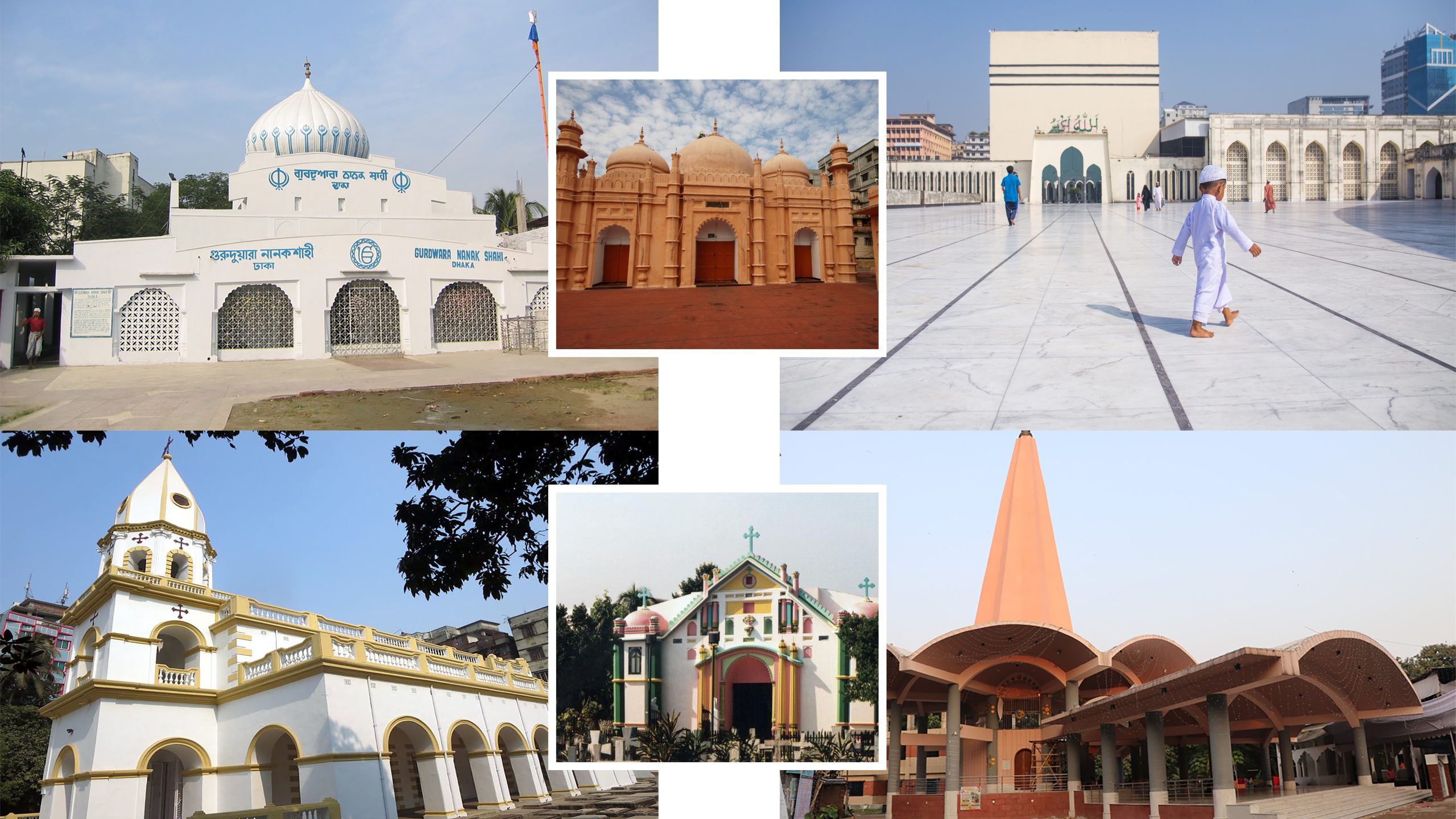
Going through the streets of Dhaka always feels like moving through chaos. It’s noisy, busy and restless. However, despite the density and turmoil, the city has another side to it.
Though Dhaka is known as the city of mosques, our city carries the co-existence of all the religious institutes beautifully. It has an amazing architecture of temples and churches alongside mosques. The local story and history behind these structures make you feel spiritually uplifted.
If you want to experience co-existence, here’s a guideline for you.
Saat Gumbuj Masjid
The mosque was constructed at a crucial site during the Mughal era (17th century). It was situated on the northwestern boundary of the Mughal Dhaka at the time, in a region known as Zafarbad or Katasur, alongside the Buriganga River.
Yet, that section of the river has now been obscured and is encircled by structures and the Seven Mosque Road (which previously lined the riverbank). This mosque not only holds history but is also famous for its architecture.
Armenian Church of the Holy Resurrection
When Armenian traders started to settle in Dhaka, they used to live in Armanitola. Before the existing church, the Armenian community utilised a small chapel located in their cemetery. As their numbers increased, a proper church became necessary.
The church remained in a state of neglect for a long period. Nevertheless, a committed individual named Michael Housep Martirossian (Michael Joseph Martin), who died in April 2020, was recognised as the “last Armenian” of Dhaka and devoted his life to safeguarding and revitalising the church and its heritage
If you enter this church now, the peaceful place will calm your mind and soul.
Khan Mohammad Mridha Masjid
This mosque is like the Lalbagh fort. It is built on a raised platform, which is 5.8 metres high from the ground level. It is recognised in the architecture community for its visual appeal and its architectural importance.
While individuals in the tourism industry might consider the ‘Tara’ as the most distinctive mosque, many architects would refer to the Khan Mohammad Mosque as the most unique.
Built by Khan Mohammad Mridha, the location has been appropriately restored, providing insight into the religious customs and architectural styles of the late 17th and early 18th century Dhaka.
Shri Shri Bura Shiv Dham
This temple is known as the most beautiful temple in Dhaka. It was established during the Mughal Empire of Jahangir. Some say the temple was constructed by an infamous robber leader, known as Khelaram. It is claimed that he would steal from the rich, assist the needy and conceal the stolen treasures in the temple.
This temple is based on the campus of the University of Dhaka, right beside Shaheed Minar.
Baitul Mukarram National Mosque
Baitul Mukarram Mosque was created in the late 1950s. The primary structure of this mosque is a large, eight-story cube, intentionally designed to resemble the form of the Holy Kaaba in Mecca, setting it apart architecturally from other mosques in Bangladesh.
When Dhaka was expanding in 1950, people felt a need for a large-scale, modern mosque. It is now one of the most popular mosques in the city, where Friday prayers are marked with thousands of devotees.
Holy Rosary Church
This church is one of the oldest in Dhaka and the second to be built. It was established by Portuguese missionaries in 1677. One cannot really tell its age by looking at it, as it has undergone numerous restorations and renovations.
The pastel shade of this church is so soothing that one feels as if all chaos and grief fade away here.
The church property has one of the two Catholic burial sites in Dhaka. The graveyard features headstones bearing inscriptions in Armenian, Portuguese, and English, reflecting its use by various Christian communities throughout the centuries. Here, one can discover some of the oldest Armenian gravestones in Dhaka.
Ramna Kali Temple
It is believed that this temple is around 100 years old. On March 25, 1971, the Pakistani army initiated Operation Searchlight, targeting the Ramna Kali Temple on March 27. The soldiers bombed the temple and violently killed over a hundred Hindus, including priests and worshippers who were present.
After 50 years, it was renovated and rebuilt in 2021. This temple is in Suhrawardy Udyan.
Gurudwara Nanak Shahi
The Gurdwara is historically significant as it marks the visit of Guru Nanak, the founder of Sikhism, to Dhaka during the early 16th century.
The existing structure of the Gurdwara was rebuilt in 1830. For a period following India’s partition in 1947, the Gurdwara was overlooked. Following Bangladesh’s independence in 1971, Sikh soldiers from India and other worshippers contributed to its restoration.
