

The last week in Bangladesh’s recent history compressed an extraordinary number of shocks into an alarmingly short span of time. It began on 12 December, when a young political leader was shot, and culminated six days later in his death, triggering ferocious mob violence in the capital, including the vandalism of two major media offices and cultural centres, and ending with the lynching of a Hindu garment worker on the outskirts of Dhaka.
What unfolded was not merely a series of isolated violent incidents, but a cascading chain reaction whose consequences have altered the country’s political trajectory, strained its diplomatic bearings, and exposed deep and unsettling vulnerabilities in its security apparatus and governance framework.
The timing of the crisis made it even more destabilising. The election commission was preparing to hold a critical parliamentary election, an exercise meant to steer the country back toward constitutional normalcy after a prolonged period of political transition.
Yet uncertainty already loomed large over whether the election would be held on time, fairly, or at all. In that fragile context, expectations were also building around the return of BNP’s acting chairman Tarique Rahman after nearly 17 years in exile in London—a development that could have significantly altered political dynamics and voter mobilisation. Instead of political re-engagement and electoral momentum, the nation was plunged into shock when a newly emerged leader in the post–Sheikh Hasina era was shot in the head and later succumbed to his injuries in a Singapore hospital.
His death became a political and social rupture. What followed was not a spontaneous outpouring of grief but a descent into orchestrated lawlessness. Violent mobs took control of the streets of the capital, openly declaring to attack two media houses and then carrying out those threats with impunity.
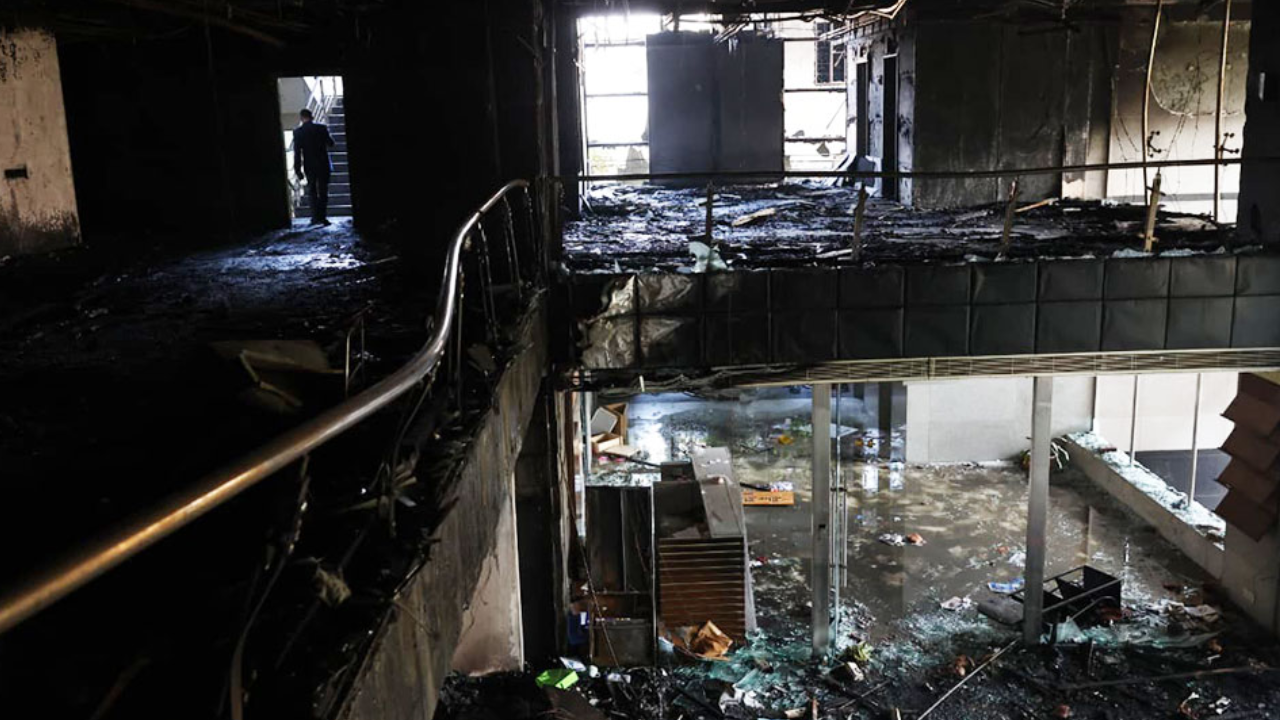
For more than five hours, two newspaper offices were ransacked and set ablaze while the state, despite possessing vast security and intelligence machinery, appeared to remain idle. This was not simply a lapse in law enforcement; it was a profound failure of state authority. When mobs can announce violence in advance and execute it without resistance, the message is well-defined: the monopoly on force has eroded.
The assault on the media carried consequences far beyond physical destruction. It struck at the heart of press freedom and public accountability. At a moment when citizens require credible information to navigate political uncertainty, journalists were left trapped and terrorised. Such attacks corrode the conditions necessary for a credible election and raise doubts about whether any forthcoming polls—if held—can be free, fair, or meaningfully participatory.
The crisis deepened further with the lynching of Dipu Chandra Das, accused of blasphemy, beaten to death and set on fire by a mob on 18 December. Although twelve people were later arrested, the sheer brutality of the killing, unfolding amid a broader wave of violence, highlighted how dangerously normalised mob justice has become. The rule of law appeared absent when it mattered most, replaced by collective vengeance and religious extremism.
This killing also pushed Bangladesh’s already strained relations with India to a new low. Protests erupted across parts of India, with angry mobs ransacking two Bangladeshi visa centres, forcing their closure.
Diplomatic fallout followed swiftly. Bangladesh summoned the Indian High Commission to express grave concern, even as protests in India continued, exposing how domestic disorder in Dhaka can rapidly spill over into regional instability.
At the centre of this turmoil lies a far more unsettling question: if the election cannot be held amid such insecurity, what lies ahead for Bangladesh? The absence of an electoral pathway would deepen the legitimacy crisis, prolong political uncertainty, and invite further unrest.
The past week has shown how quickly disorder can spread when authority falters. Whether the state can restore order, protect democratic institutions, and ensure a credible election may well determine the country’s immediate future and its standing at home and abroad.
