

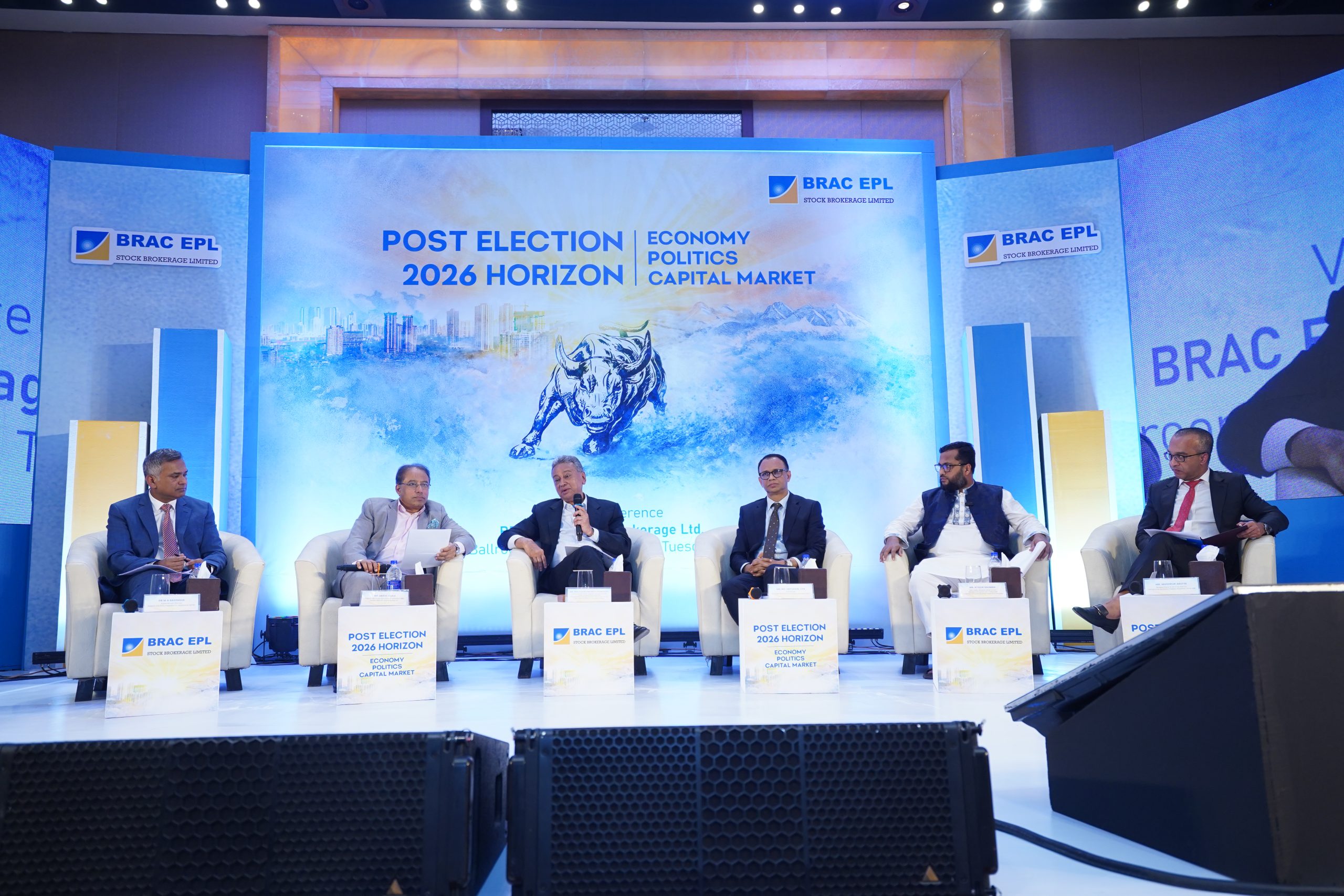

As Bangladesh moves into a decisive post-election phase, political legitimacy, reforms and investor confidence will matter more than the applauded short-term stability, economists, regulators, political leaders and foreign investors said at a major Dhaka conference.
Organised by BRAC EPL Stock Brokerage, the “Post Election 2026 Horizon: Economy, Politics & Capital Market” conference brought together speakers who were blunt that recent stabilisation has only bought time and failed to address long-prevailing structural weaknesses across the economy and financial system.
Economist M A Razzaque, chairman of think tank Research and Policy Integration for Development, said Bangladesh is navigating three transitions at once, each carrying significant risk if mishandled.
At the centre of these shifts are the political transition linked to the election, macroeconomic stabilisation under support from the International Monetary Fund (IMF) and graduation from least developed country status in November.
“We are going through three critical transitions that are going to shape our economy and, to some extent, our future as well,” Razzaque said, warning that managing all three simultaneously would severely test policy capacity.
Despite growth slowing and falling below the South Asia average, Bangladesh has avoided the sharp contractions seen in other economies undergoing political and economic adjustment, he said.
“In the case of Bangladesh, we still have solid and robust economic growth. That is a positive feature of the Bangladesh economy,” Razzaque said, cautioning that resilience should not be mistaken for strength.
Looking ahead, he said projections by the World Bank and the IMF point to growth of about 5.7 per cent by 2027 and around 6.5 per cent by 2030, but stressed that these outcomes hinge on reform momentum after the election rather than continuity alone.
On graduation from LDC status, Razzaque urged realism. While around 75 per cent of Bangladesh’s exports rely on trade preferences, near-term risks remain limited as extensions have been secured in key markets. Preferential access to the European Union will continue until November 2029, while Japan and the United Kingdom have granted three-year extensions. He also cited the Bangladesh–Japan Economic Partnership Agreement as a longer-term opportunity once fully implemented.
Beyond 2029, however, uncertainty, the withdrawal of export subsidies and tighter intellectual property rules will force Bangladesh to compete on factors beyond price, he warned.
“Competitiveness today is not only about price. It also involves quality, worker rights, factory standards and environmental protection,” Razzaque said, calling for industrial upgrading and export diversification.
Questions of political accountability featured prominently in the discussion. BNP Standing Committee Member Amir Khasru Mahmud Chowdhury said prolonged weak accountability has damaged confidence across the economy.
“We need an elected government that will be accountable to the citizens,” he said, arguing that many economic distortions are political rather than technical in nature.
For more than 10 years, the capital market has remained “largely non-functional”, Chowdhury said, forcing excessive reliance on banks and worsening stress in the financial sector.
“If the capital market were functioning properly, not only private corporations but also the government could raise funds domestically,” he said, questioning why Bangladesh continues to rely on external borrowing despite domestic savings.
From the regulatory side, Bangladesh Securities and Exchange Commission Commissioner Md Saifuddin said post-election reforms are aimed at rebuilding trust by fixing market foundations rather than stimulating activity.
“Sustainable confidence is not built on sentiment. It is built on institutions, trust and infrastructure,” he said.
According to Saifuddin, reforms are focused on stricter disclosure, improved corporate governance, new mutual fund rules, disciplined margin lending and stronger market infrastructure to ensure capital flows to transparent and well-governed enterprises.
Stress in the banking sector was also laid bare. City Bank Managing Director and CEO Mashrur Arefin flagged weak capital adequacy, noting that the Basel requirement is 12.5 per cent while the sector currently stands at around 4 per cent.
Some banks remain strong and investable, Arefin said, adding that a market-driven exchange rate, tighter monetary discipline and adequate liquidity are helping restore stability. Still, unresolved weaknesses continue to weigh on confidence, he warned.
From abroad, foreign investors said political clarity after the election will determine whether capital returns.
Tundra Fonder AB Chief Investment Officer and Founding Partner Mattias Martinsson, whose Stockholm-based fund invests in frontier markets, said Bangladeshi stocks are trading near historic valuation lows and could see a broad-based recovery once election uncertainty clears. Capital gains tax complexity and limited market depth, however, remain key constraints, he said.
Contextual Investment LLC Managing Director Takao Hirose, who invests across Asian frontier markets, said overseas investors are unwilling to commit capital ahead of the election and want to see stability alongside early reform signals.
Speaking from London, BlackRock Co-Head of the Emerging Markets and Frontiers team Gordon Fraser described the period as “a really exciting time”, but warned that unresolved non-performing loans and weak banks could derail the investment case if left unaddressed.
Closing the discussion, M A Razzaque delivered a blunt message for the next government, saying crisis management must be the immediate priority.
“Reform signals in the first 100 days after the election will determine whether Bangladesh can convert stabilisation into renewed growth and sustained investor trust,” he added.
Alongside challenges, the economist also highlighted the potential of the economy and investment opportunities in a wide range of sectors.
