

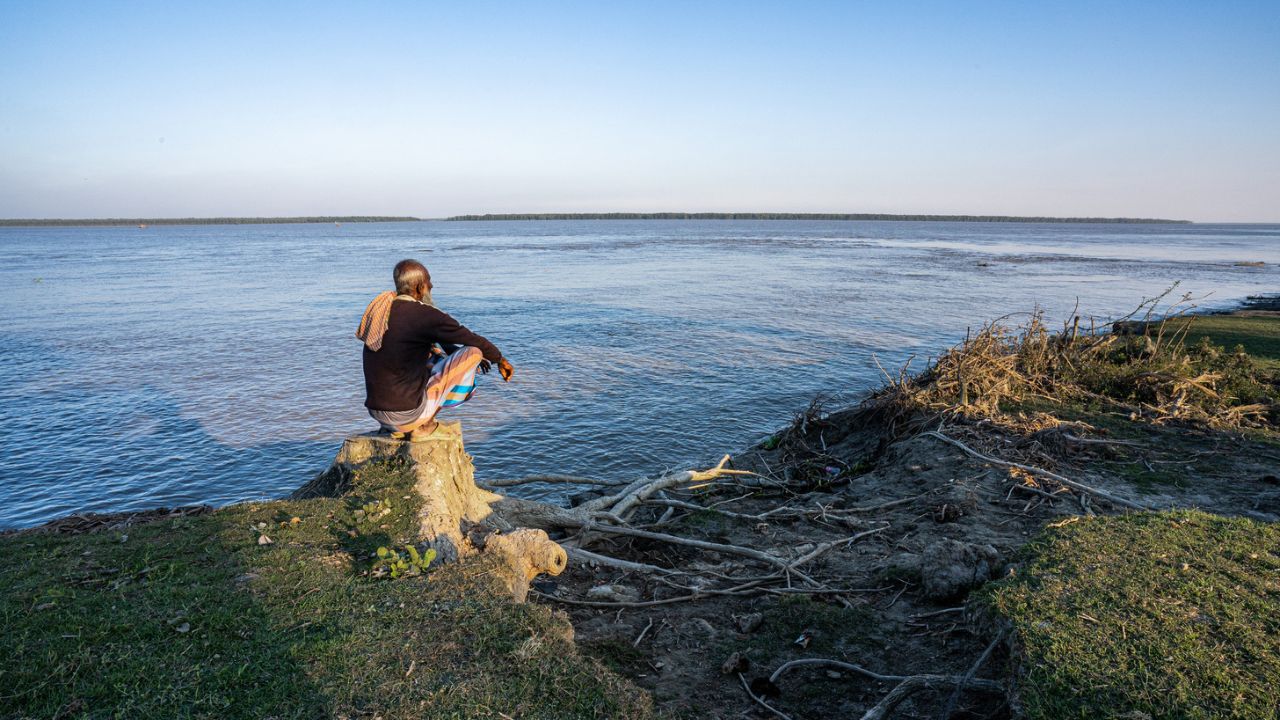
Before the river takes the land, it takes the silence. A crack runs through the soil, a line appears where there was none the day before, and by morning, the edge of Monpura has shifted again. What looks solid on a map is fragile underfoot. On this island upazila in Bhola, the Meghna does not announce its arrival with floods alone. It arrives by subtraction, steadily redrawing the boundary between land and water.
Satellite data from the Bangladesh Water Development Board (BWDB) leaves little room for debate. Over the past two decades, Monpura has lost more than 10 square kilometres of land to the Meghna River. That is roughly the size of 1,400 football fields. In the most erosion-prone stretches, the river consumes between 150 and 200 metres of coastline every year. The numbers trace a shoreline that is no longer stable, but retreating, measured, mapped, and steadily vanishing.

For the people who live here, erosion is not an abstract statistic. It is a recurring disaster. The Meghna’s violence lies in its dual nature. The same river that once deposited the fertile silt that gave birth to Monpura now tears it apart.
During the monsoon, swollen by upstream rainfall and tidal pressure, sediment-heavy currents slam into the banks with hydraulic force. This is not a gradual loss. Entire chunks of land collapse without warning. A single surge can erase 30 to 50 metres overnight, dragging trees, tin-roofed houses and ponds into the muddy water.

Along much of the coastline, geo-bag dams now stretch for kilometres, rows of sand-filled bags stacked as a last line of defence. Each bag represents one cubic metre of resistance. Together, they form a barrier against a river whose power is measured in cubic kilometres of flow. Engineers call it mitigation. Residents call it survival.
Mohammad Hossain stands near the dam and points toward the water. “My bedroom was there,” he says, quietly. He measures the loss not in hectares or coordinates, but in steps, the few paces between the dam’s edge and the place where his home once stood. That distance is now marked only by depth.

The arithmetic is unforgiving. The river’s capacity to destroy now far outweighs its ability to create. While protective structures slow the damage, they cannot reverse it. Monpura’s fight is not just against erosion, but against time itself. It’s like a slow-motion disappearance, measured precisely, and lived painfully, day by day.
