

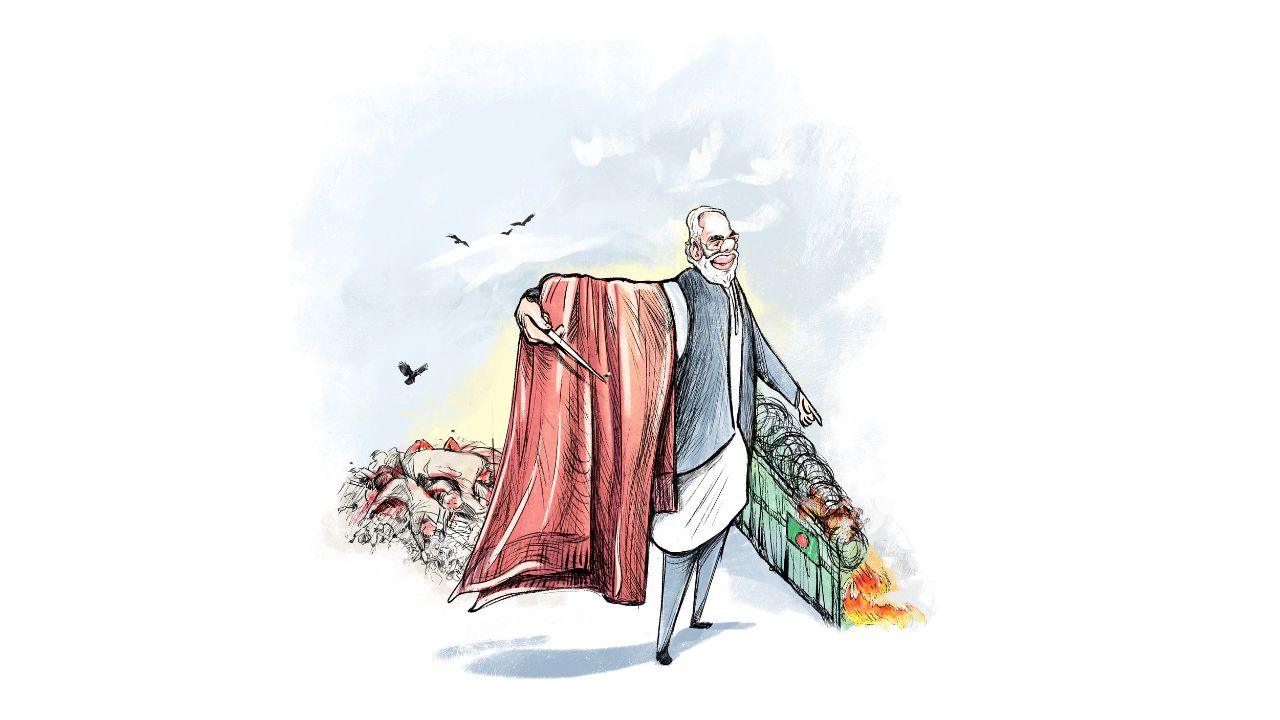
On Christmas Day, Indian Prime Minister Narendra Modi visited a church in Delhi and offered prayers, even as members of hardline Hindutva groups backed by his party and government went on the rampage against Christians in different states across the country, attacking them and obstructing religious practices.
Most of the attacks took place in BJP-ruled states such as Madhya Pradesh, Uttar Pradesh, Rajasthan, Assam and Haryana.
In Assam’s Nalbari district, the Bajrang Dal vandalised a Christian missionary school. This organisation, along with the Vishwa Hindu Parishad (VHP), took an aggressive stance against Christmas celebrations in various states.
Similar incidents occurred on December 24 across several BJP-ruled states, including cities such as Jaipur, Vidisha, Bhopal, Guwahati, Bareilly and Indore. Members of the VHP and Bajrang Dal attacked shopping malls, schools, shops, and even people celebrating the festival.
In Kerala’s Palakkad district, members of the Rashtriya Swayamsevak Sangh (RSS), a far-right Hindu nationalist organisation, of which Modi is also a member, went door to door in Pudusseri village and stopped people from singing Christmas carols. In Haridwar, in BJP-ruled Uttarakhand, a Christmas programme at a hotel run by the state tourism department on the banks of the Ganges was halted.
What is striking is that the BJP did not protest these attacks. There was no condemnation or statement from the central government.
The Modi government’s approach to violence against minority communities reveals a troubling double standard. New Delhi remains conspicuously silent when Christians and Muslims face attacks within India but becomes strikingly vocal when incidents involving Hindus occur in neighbouring countries. This selective outrage exposes political hypocrisy.
In recent years, India has witnessed repeated attacks on religious minorities, particularly Christians, during festivals, prayer meetings and routine religious practices. Christmas celebrations disrupted by Hindutva groups, churches vandalised, carol singers stopped, and worshippers assaulted are no longer aberrations but recurring events.
These incidents are concentrated largely in BJP-ruled states and often involve organisations ideologically aligned with the ruling party. Yet official condemnation from the highest levels of government is either absent or muted. The prime minister, senior ministers and party leadership rarely acknowledge these attacks, let alone take responsibility for creating an environment of impunity.
The Modi government has maintained this stance despite reports in many Indian and many international media outlets.
Recently, the Catholic Bishops’ Conference of India “unequivocally condemned” what it described as an “alarming” rise in targeted attacks on Christians across the Hindu-majority country. Human rights organisations have also accused Hindu vigilante groups of vandalising churches, ransacking Christmas decorations and threatening people celebrating Christmas in multiple locations. Christian watchdog Open Doors said it recorded more than 60 alleged attacks targeting Christians across India during the Christmas period.
Amid this, on Friday—a day after Christmas—the Indian Ministry of External Affairs held its regular briefing, where spokesperson Randhir Jaiswal answered various questions from journalists but made no comments on protests and attacks by Hindutva groups targeting Bangladesh missions in different Indian states, or on the series of attacks against Christians during Christmas.
This silence is not accidental. It reflects a political calculation in which acknowledging minority persecution would challenge the ideological foundation of Hindu majoritarianism that the ruling establishment has carefully nurtured.
By downplaying or ignoring such violence, the government effectively normalises it. Law enforcement responses tend to be selective, with victims sometimes criminalised under allegations of forced conversion, while perpetrators walk free or face minimal consequences. Violence against minorities appears tolerable so long as it aligns with the dominant ideological narrative.
In sharp contrast, the BJP government is quick to issue statements, summon diplomats, or raise concerns at international forums when reports of violence against Hindus emerge in neighbouring countries. Isolated incidents are framed as systemic persecution, and moral outrage is amplified through official briefings, social media campaigns and sympathetic media outlets.
This asymmetry raises uncomfortable questions. If religious violence is unacceptable in principle, why does that principle apply selectively? Why does India demand accountability from other governments while evading it at home?
Such double standards carry serious consequences. They erode India’s credibility as a democratic republic committed to secularism. When the government speaks loudly about minority rights abroad but remains silent at home, it weakens its diplomatic standing and invites accusations of hypocrisy. More dangerously, it signals to extremist elements within the country that state power will shield them, fostering a culture of impunity that threatens social cohesion.
Until the Modi government confronts violence against minorities within its own borders with the same urgency it displays abroad, its claims of moral authority will ring hollow—both at home and on the global stage.
