

According to the First National Study on Trafficking in Persons in Bangladesh, people of all genders and age groups are at risk of domestic and cross-border trafficking. Under Bangladeshi emigration regulations, labour migration involves high fees, which many young women in particular struggle to pay, given the economic marginalization of many women in Bangladesh. Thus, some seek migrant smuggling services to travel abroad, heightening their risk of trafficking in persons and aggravated forms of smuggling of migrants. Women and girls are trafficked and sexually exploited, while men and boys in particular are trafficked into forced labour domestically and internationally, in sectors such as construction, agriculture and service industries.
Boys and girls are targeted by traffickers and subjected to different forms of exploitation, such as forced labour, sexual exploitation, exploitative begging, forced criminal activities and forced marriage. Regionally, long and porous land borders are conducive to international transfer of trafficking victims by land. Traffickers facilitate the passage of their victims on foot into India along the eastern borders of Bangladesh, facing few, if any, border controls. Meanwhile, traffickers make use of the same sea routes as migrant smugglers, with victims leaving from the ports along the southern sea border in the Bay of Bengal.
Human trafficking has emerged as a great challenge for the entire world. The situation of human trafficking in Bangladesh is no different from the other countries of Asia. Human trafficking is a crude form of trade in human beings which aims to earn profit through sexual slavery, forced labour, debt bondage, and removal of organ for the purpose of trade. It snatches away personal liberty and undermines personal safety and dignity along with physical and mental freedom. The victims of human trafficking are usually entrapped and exploited by third parties. With the assistance of the national and international development partners, the government of Bangladesh is effectively engaged in prevention and suppression of this crime.
Although chiefly a source country for human trafficking, Bangladesh in recent years has become a transit and destination country. In recent times, alongside internal and cross-border trafficking in women and children, trafficking in men for labour exploitation has been on the rise. In Bangladesh, a significant number of men and women are recruited for work overseas with fraudulent employment promises and often later face exploitative andumane conditions in the form of forced labour or debt bondage.
The issue of trafficking is integrally linked to insecurity of livelihood as well as to continuing disparities and discrimination against marginalized communities generally, and against women in particular. Many trafficked persons are lured and deceived by false promises of good jobs or marriage and some are bought, abducted, kidnapped, coerced, threatened with force, or used as debt bondage. Some of these women and children are trafficked with the tacit consent of their poverty-stricken families.
The Government of Bangladesh has taken up the initiative to combat human trafficking as a priority. There is both internal and cross-border human trafficking in Bangladesh. In case of internal trafficking, men, women and children are often trapped through false promises of a better life and work or marriage. The traffickers enslave them and engage them in such crude sectors as sexual exploitation, forced labour, or brickfields, which demand hard labour. Often, marginalized households and households affected by natural disasters or seasonal unemployment in rural Bangladesh become easy targets for traffickers. In the face of economic, social and gender discrimination in these households, women and children’s livelihoods are under crisis and have high levels of social insecurity. The women, children and men who are victims of cross-border trafficking are moving out of their rural addresses to go to India, Pakistan, and Malaysia, as well as various countries in the Middle East. In the case of cross-border trafficking, men are exposed to no lesser risks.
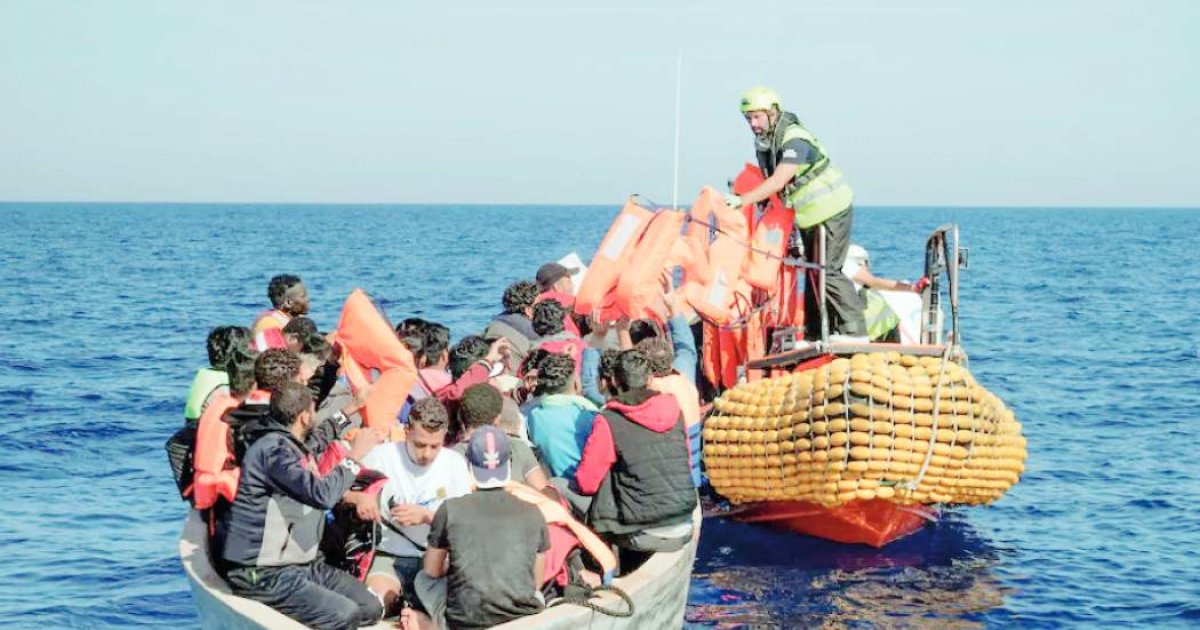
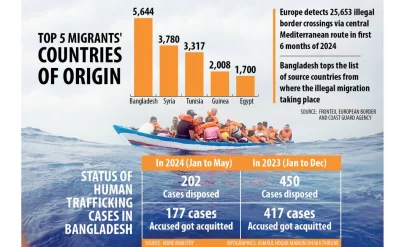
Such trafficking often takes place under the guise of labour migration. The First National Study on trafficking in Persons in Bangladesh revealed, some Bangladeshis, especially men, are recorded using the Mediterranean Sea routes to travel irregularly to Europe, both prior to and during the Covid-19 pandemic – they are often subjected to human trafficking.
Although a land route is utilized for cross-border trafficking to India, in general, water and aerial routes are typically utilized for cross-border trafficking and several countries are used for transit and destination. India and Pakistan are both transit and destination countries for trafficking cases originating in Bangladesh. Sometimes, in the case of labour migration from Bangladesh, even when the job contract, visa and travel documents are genuine, our citizens on arrival to the destinations realize that instead of the promised job, they are forced into exploitative work environment with low or no pay.
Human trafficking is a clandestine, organized and complex process carried out by organized, international chains of criminals. As a result, it is almost impossible for the government to combat this crime in isolation. Moreover, due to fear of social discrimination and stigma, threats from the criminals, absence of access to legal assistance, and lack of awareness of legal provisions, in most cases, trafficking victims and their family members avoid the legal system of seeking justice. As a result, the true prevalence of trafficking is hidden.
This also decreases the likelihood of punishing the criminals and delivering justice to the victims. Considering this complex context, along with addressing the legal constraints, Bangladesh has specifically identified poverty, illiteracy, lack of awareness, unemployment, gender discrimination, domestic violence, and natural disasters as critical causes of human trafficking (please see the 2008 and 2012 NPAs). Through consecutive NPAs, the country has stressed resolving such socioeconomic problems as poverty and domestic violence along with developing mechanisms for promoting safe migration. Marginalized and migrating populations, living nearby or far from the border, are exposed to the risk of trafficking. In the border areas, there is a high prevalence of trafficking and traffickers as there is a history and tradition of cross-border mobility and a kind of prevailing tolerance among the border communities for irregular mobility. Access to safe migration and lack of awareness on safe migration escalates the risk of trafficking among the labour migrants. Child marriage, dowry, eve teasing, domestic violence and other forms of gender-based violence and discrimination push women and children into a high-risk category.
(Source: National Plan of Action for Prevention and Suppression of Human Trafficking)
