

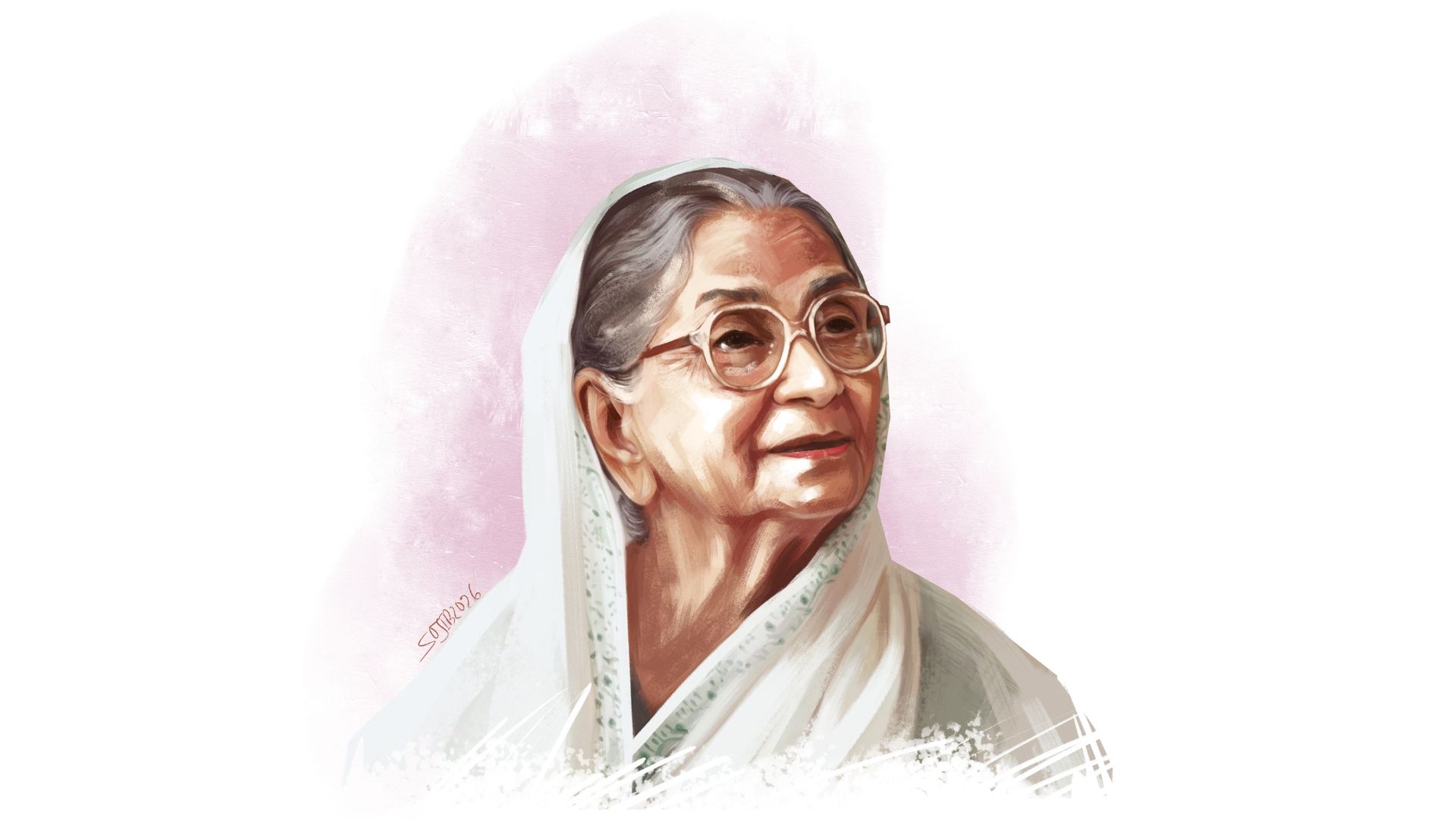
Some lives do not simply pass through history; they shape its moral direction. Begum Sufia Kamal was one such life, a quiet yet unyielding force who became the conscience of a nation still finding its voice.
Born on June 20, 1911, in the riverine town of Shayestabad in present-day Bangladesh, Sufia Kamal entered a world already marked by rupture. Her father abandoned worldly life for spiritual asceticism when she was an infant, leaving her in the care of her mother, Sabera Begum.

Within the enclosed world of a zamindar household, her mother taught her Bengali literacy, an act that would later bloom into quiet rebellion.

Like most girls of her time, Sufia’s childhood was brief. At just twelve, she was married off under prevailing social customs. Widowhood arrived early, along with the weight of responsibility for a child. Yet grief did not define her; it refined her. She remarried, rebuilt her life, and began to write steadily, turning private endurance into public voice.

Her literary journey began early and boldly. Her first poem, Basanti, was published in Saogat in 1926. In 1938, her poetry collection Sanjher Maya was released, earning rare admiration from literary giants such as Kazi Nazrul Islam and Rabindranath Tagore. For a young Muslim woman in a deeply conservative society, this recognition was not just an achievement; it was defiance.

But Sufia Kamal was never confined to poetry alone. She stepped into public life whenever history demanded courage. During the Language Movement of 1952, she stood with protestors demanding linguistic dignity. In 1961, she resisted cultural repression under the Pakistani regime. By 1969, she had helped organise women through the Mohila Sangram Parishad, ensuring that their voices were part of the national struggle.
The defining test came in 1971. Under military occupation, Sufia Kamal became part of a silent resistance network, channelling food and medicine to freedom fighters through trusted couriers. When pressured to sign a denial of atrocities, she refused without hesitation. “I would rather die,” she said, “than put my signature on a false statement.” It was not rhetoric, it was principle lived to its final edge.
After independence, she turned her moral energy toward rebuilding society. She led the Bangladesh Mahila Parishad for years and became the founding Chairperson of BRAC, reinforcing her belief that liberation was incomplete without women’s emancipation.
Sufia Kamal passed away on November 20, 1999, and was given a state funeral, the first woman in Bangladesh to receive such an honour. What she left behind was more than poetry or activism.
