

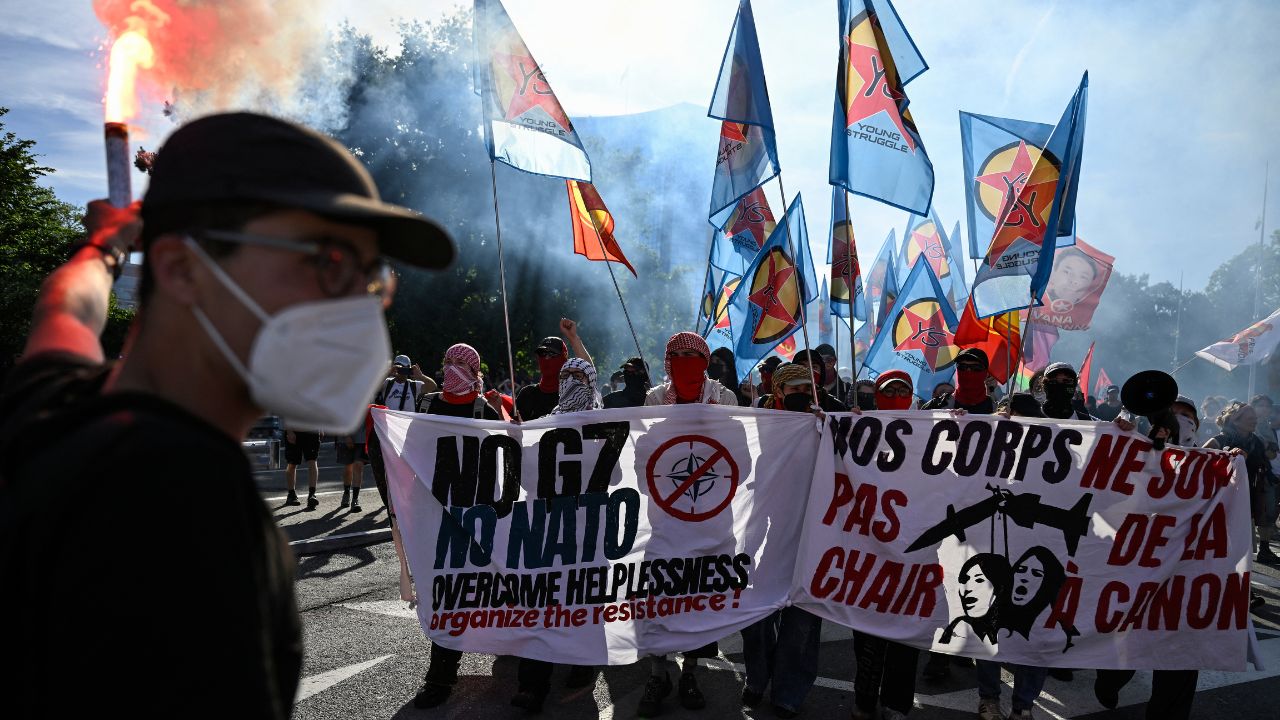
Geneva was thrown into tension and tear gas on Sunday, June 14, as a largely peaceful demonstration against the G7 summit in nearby Evian, France, descended into sporadic violence.
This forced police to deploy water cannon and crowd-control measures across parts of the Swiss city.

An estimated 20,000 people marched through Geneva, joining a cross-border wave of protest aimed at the gathering of leaders from the world’s richest democracies, which opens on Monday across Lake Geneva in the French spa town of Evian.


The march had been officially authorised and routed away from the city’s luxury shopping districts to avoid the kind of destruction seen during past summit-related unrest.
For much of the day, the demonstration moved peacefully under intense summer heat.

Protesters carried Palestinian flags, climate banners, and anti-capitalist slogans, chanting against global inequality, military alliances, and what they described as “decisions made far from ordinary lives.”

Placards reading “No to the G7 and all imperialist alliances” and “Abort the G7” reflected the broad ideological mix of the crowd.
As the procession advanced, police said a splinter group of several hundred black-clad activists broke away from the main demonstration.
These so-called “Black Bloc” participants allegedly smashed barricades, vandalised property, and targeted buildings near residential and international institutional areas, including sites close to United Nations offices.

A burning Tesla car, marked with the words “Eat the Rich,” became one of the most striking images of the unrest.
Authorities said around 600 individuals were involved in the most violent incidents. Riot police responded with tear gas and water cannon as scattered clashes erupted across multiple locations.

The G7 summit itself, held just across the lake, is expected to focus heavily on global security crises, including the ongoing war involving Iran, as well as the conflict in Ukraine.
French President Emmanuel Macron arrived in Evian on Sunday ahead of the opening sessions, as thousands of Swiss and French security personnel were deployed across the region in one of the largest coordinated operations in recent years.

By nightfall, calm gradually returned to parts of Geneva, but the aftermath lingered in shattered glass, scorched streets, and heavy police presence.
As the G7 leaders prepared to meet, the city was left to reckon once again with how quickly a message of dissent can spill into scenes of confrontation.
