

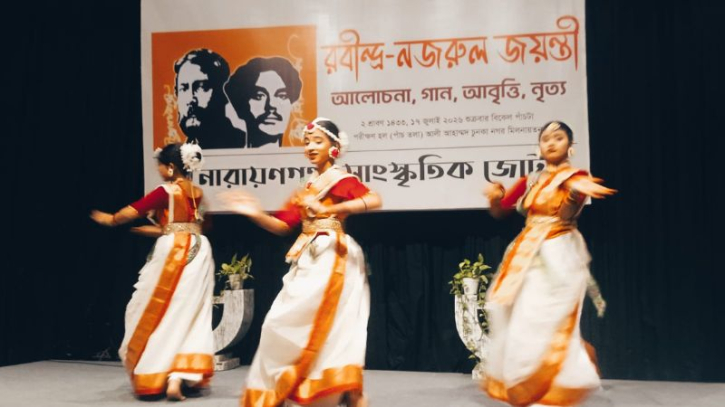
Narayanganj Sangskritik Jote celebrated the birth anniversaries of Nobel laureate poet Rabindranath Tagore and National Poet Kazi Nazrul Islam through discussions, songs, and poetry recitations.
The discussion and cultural program were held on Friday (July 17) at 5:00 PM at the testing hall on the fifth floor of the Ali Ahammad Chunka Library in the city.
The program started with the Rabindra Sangeet ‘Tumi Je Surer Agun Lagiye Dile Mor Prane’. Later, children performed songs like ‘O Amar Desher Mati, Tomar Pore Thekai Matha’ and Nazrul’s ‘Kandari Hushiyar’. Various other songs and poems by Tagore and Nazrul were also performed.
Dina Tazrin, the general secretary of Narayanganj Sangskritik Jote, gave the welcome speech at the event, while the organization’s president, Moni Supanth, gave the closing speech.
At the discussion, the speakers said that the year 2026 holds a special meaning for Narayanganj. On February 27, 1926, Rabindranath Tagore was given a reception in Narayanganj. In the same year, on July 2, Kazi Nazrul Islam visited Narayanganj and wrote his famous poem ‘Abhijaan’. This year marks the 100th anniversary (centenary) of these two historic events.
Rafiur Rabbi, the chief advisor of the Sangskritik Jote and a cultural personality, said that Rabindranath Tagore came to Narayanganj by steamer via Goalondo to attend a reception at Dhaka University. When people heard about his arrival, about two hundred students and teachers of Narayanganj High School brought him to the school and gave him a reception. In that event, a ninth-grade student named Kamakhyacharan read the welcome message, and Rabindranath gave a long speech. Various newspapers of that time, especially the Amrita Bazar Patrika, published this news with great importance.
He also said that Kazi Nazrul Islam came to Narayanganj in the same year to name and bless a monthly magazine called ‘Abhijaan’, which was being published by Abul Kasem. Nazrul’s famous poem ‘Abhijaan’ was written for this magazine. Although the magazine was later published from Kolkata, its first edition was printed in Narayanganj.
Rafiur Rabbi mentioned that there is no reliable historical proof that Nazrul wrote the poem ‘Abhijaan’ while sitting at the Narayanganj Club. He added that the song ‘Kandari Hushiyar’, written in the context of the 1926 Kolkata communal riots, has a special historical value. Although Nazrul grew up as an artist singing Rabindra Sangeet, he created his own unique style in Bengali music through his talent and creativity.
He further said that both Rabindranath and Nazrul faced various oppositions during their times. However, while opposition to Rabindranath was mostly limited to literary and intellectual circles, Nazrul had to face criticism from religious groups, the government, and contemporary writers. For his poem ‘Anondomoyir Agomone’ published in the ‘Dhumketu’ magazine, the British government arrested him on sedition charges and jailed him. At that time, Rabindranath showed his support for Nazrul.
Rafiur Rabbi also said that many ideas in society about the relationship between Rabindranath and Nazrul do not have a historical basis. We have failed to truly evaluate them because we judge them based on narrow religious identities.
He concluded by saying that as long as oppression, discrimination, and injustice exist in the world, Nazrul will remain relevant. The humanistic spirit of his poems like ‘Bidrohi’ and ‘Kandari Hushiyar’ will inspire the new generation to fight for equality, harmony, and human freedom.
