

Summers in Saskatoon are short and warm, in stark contrast to its long, bitterly cold winters. Six summers ago, when I visited Saskatoon—the largest city in the Canadian province of Saskatchewan—in July 2019, it was one of the sunniest times of the year.
The air in Saskatoon was thick not only with the warmth of sunny days but also with the intellectual hum of more than 900 scientists and scholars. They had gathered for the 1st International Wheat Congress (IWC), a symphony of genetics, breeding, and trade. Situated in the heart of Canada’s breadbasket, Saskatoon was the perfect host for a gathering of this magnitude.
I was there as one of ten international journalists, a witness to the weighty discourse on feeding a hungry world. Yet after days of peering into the microscopic details of wheat, I found myself yearning for the infinite.
I remember clearly the moment when the walls of the congress seemed to close in. It was my friend Michael Robin, a science writer of high repute, who offered the antidote: a midnight stargazing expedition. I jumped at the invitation.
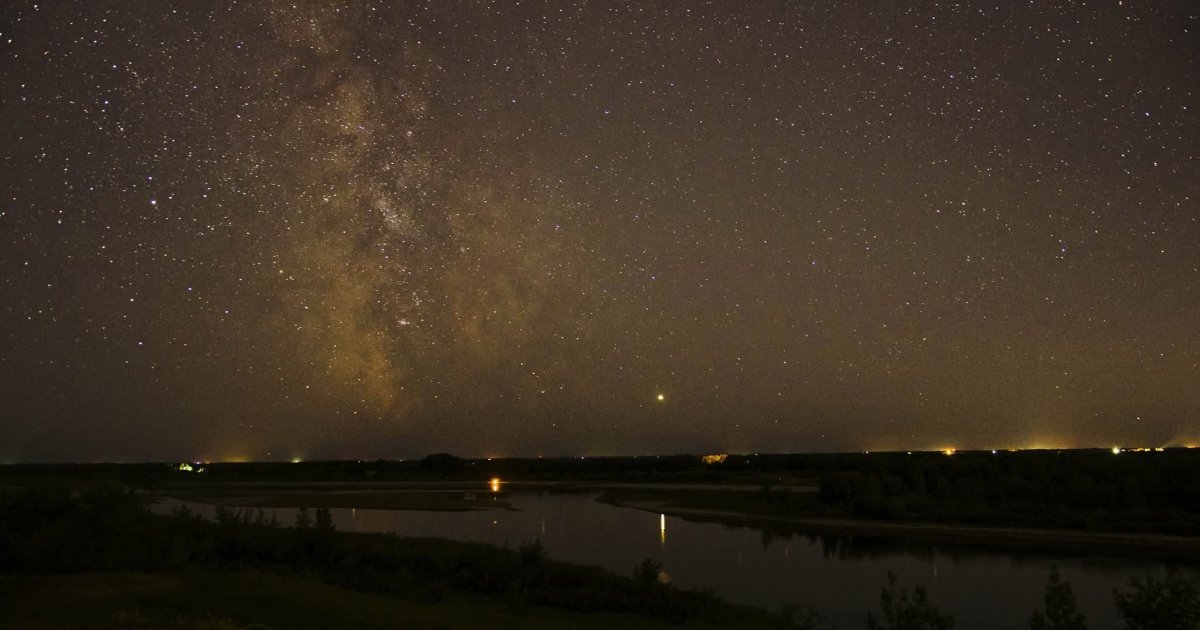
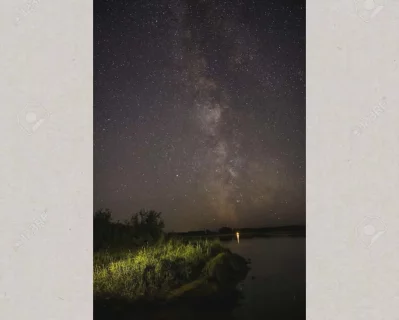
Around midnight on a late July night, Robin picked up our small group—Amit, Amin, Tan, and me—and drove 16 kilometres south of the city to Cranberry Flats. This scenic conservation area along the South Saskatchewan River is a favourite among daytime hikers, but we were there for a celestial show. We hoped for a clear sky and, if luck was on our side, a glimpse of the Northern Lights (aurora borealis).
Amit Bhattacharya, a journalist friend from India, was the astrophotographer among us, always carrying gadgets to navigate the night sky and capture images wherever he travelled. This was the farthest north he had ever been. By the time we were settling deep inside the Cranberry Flats reserve by the river, acclimatising ourselves to the thrill of seeing glittering stars up close in a clear sky, Amit had already set up his telescope, night-vision lights, and camera gear.
Far from the city’s light pollution, the galaxy revealed itself with surreal clarity. From our vantage point on the riverbank, amid rustling shrubs, the sky appeared as a vast canvas exploding with silent colour.
Robin has a strong knowledge of astronomy and can easily identify stars in the night sky. I benefited greatly from his familiarity with constellations. Pointing to a specific patch of the Saskatoon sky, he identified the Big Dipper—the famous asterism within the Ursa Major constellation. Once he pointed out the seven bright stars forming that iconic ladle shape, it became impossible to miss.
He then indicated something very bright, cream-coloured, and not twinkling. “Do you know what that is?” he asked. “That’s Jupiter.” The planet can be identified by its steady, intense glow, often seen near the Moon or prominent constellations such as Gemini.
Looking at the clear sky, far removed from civic light pollution, I pointed to a bright star, recognizing it as the North Star, though I still sought Robin’s confirmation. He nodded in affirmation. Ancient mariners used Polaris as a fixed point for navigation. Because it sits almost directly above the Earth’s North Pole, it appears stationary while the rest of the cosmos rotates around it.
There was little expectation of seeing the Northern Lights in full from Cranberry Flats, particularly in July. Still, the spectacle of faint auroral glows and the sight of stars and planets appearing so bright and close in the dark night sky made for an unforgettable experience. The best seasons to observe the Northern Lights from Cranberry Flats are autumn (September to October) and spring (February to April).
The Northern Lights, also known as the aurora borealis, are a natural light display in the Earth’s sky, primarily visible in high-latitude regions near the Arctic. They appear as shimmering curtains or waves of colour that seem to dance across the night sky. The phenomenon is caused by interactions between charged particles from the Sun and the Earth’s atmosphere.
Cranberry Flats Conservation Area is indeed an excellent spot for stargazing. Its distance from city lights offers a far clearer view of the cosmos—and, at times, the Northern Lights—than the city itself.
The journey to the South Saskatchewan riverbank was memorable as well. Along the way, the car’s headlights caught deer leaping out of the woods. Spotting wildlife and a variety of shrubs and plants in the dead of night was an added bonus.
I had heard of other common residents of the Flats—foxes, squirrels, coyotes, beavers, and rabbits—but amid the darkness of the wee hours, I could only spot a few deer moving swiftly and cautiously from one bushy patch to another, likely foraging for browse.
Cranberry Flats, named after the highbush cranberry native to the river flats, features a mix of sandy riverbank, native prairie, and forest ecosystems that support a wide range of species. Saskatoon berries, juniper berries, and wolf-willow grow alongside highbush cranberries. The highbush cranberry is an ornamental shrub native to North America, known for its edible, tart red berries (drupes) used in jellies, sauces, and syrups.
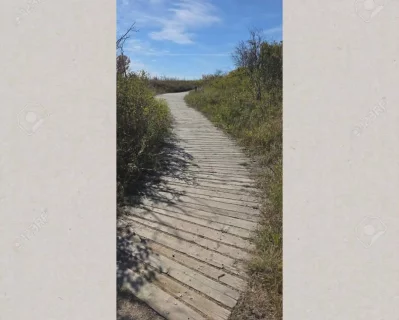
Wildflowers such as Prairie Smoke, Wild Bergamot, and the rare Yellow Lady’s Slipper orchid are commonly found in the area. Willow, aspen, and cottonwood trees line the trails, which wind through native prairie and tall grasses toward the sandy banks of the South Saskatchewan River.
By the time we returned to our hotel, dawn was breaking. The experience remained etched in my memory, acting as a bridge to my childhood in rural Bangladesh. It reminded me of evenings spent gazing at the stars under dark skies from the open courtyards of village homes during year-end holidays.
Stargazing in rural Bangladesh before the spread of electricity was less a planned activity and more a nightly immersion. It was an era of true darkness—unpolluted by electric lights—illuminated instead by swarms of fireflies and the dim, flickering amber glow of kerosene lamps.
The transition from dusk to night felt like a slow, rhythmic descent into another world, where the sky was a realm of mystery, dotted with stars and constellations named after mythical figures. In that profound darkness, the sky did not feel like a distant ceiling but rather a sparkling canopy hanging just above our young heads. The Moon would peek through the bamboo grove behind our home.
On the banks of the South Saskatchewan River, thousands of miles from that village courtyard, the stars were the same universal treasure—connecting a childhood in the East with a midnight expedition in the West.
