

The annual homeward migration before Eid is one of the most predictable social phenomena in Bangladesh. Millions of people working in cities prepare weeks in advance to return to their villages, often enduring crowded terminals, inflated fares, and uncertain schedules.
Yet this year, the familiar chaos has taken on a more unsettling dimension. Advance bus tickets are being cancelled, passengers are being asked to pay higher fares, and transport operators are citing a looming fuel shortage as the reason.
At the same time, official assurances insist that there is no shortage at all. The contradiction between these two realities says much about the fragile foundations of the country’s energy security.
The spectacle unfolding at bus terminals is therefore not merely about cancelled trips or frustrated passengers. It is a reminder of how deeply Bangladesh’s daily life and economic stability depend on a supply chain that lies far beyond its borders. Whenever geopolitical tension erupts in distant oil fields or shipping lanes, the consequences eventually arrive at the ticket counters of Gabtoli or the pumps of neighbourhood filling stations.
What led to this?
This time, the trigger is the escalating conflict in the Middle East. That region remains the beating heart of the global energy market, supplying a substantial portion of the world’s oil and liquefied natural gas. When instability threatens shipping routes or production facilities there, global prices react instantly. Markets move first, governments respond later, and ordinary people feel the impact last but most painfully.
Bangladesh’s predicament lies in the fact that its energy system has been gradually engineered to depend heavily on imported fuels. Over the past two decades, policy decisions have increasingly prioritized imports of LNG, coal, and petroleum products over domestic exploration or renewable expansion.
What once began as a temporary measure to meet rising demand has slowly hardened into structural dependence.
The numbers reveal the scale of this reliance. A significant portion of the country’s energy consumption now comes from imported sources, and the annual cost runs into billions of dollars. Each tanker arriving at Chittagong port carries not only fuel but also the weight of foreign exchange pressure, fiscal subsidy, and geopolitical vulnerability. As long as these ships arrive on schedule, the system appears stable. When uncertainty disrupts global supply chains, the illusion of stability begins to unravel.
The current situation illustrates this paradox clearly. Official statements insist that adequate fuel stocks exist. Ships carrying LNG and petroleum products are arriving, and the country’s reserves remain sufficient for normal consumption.
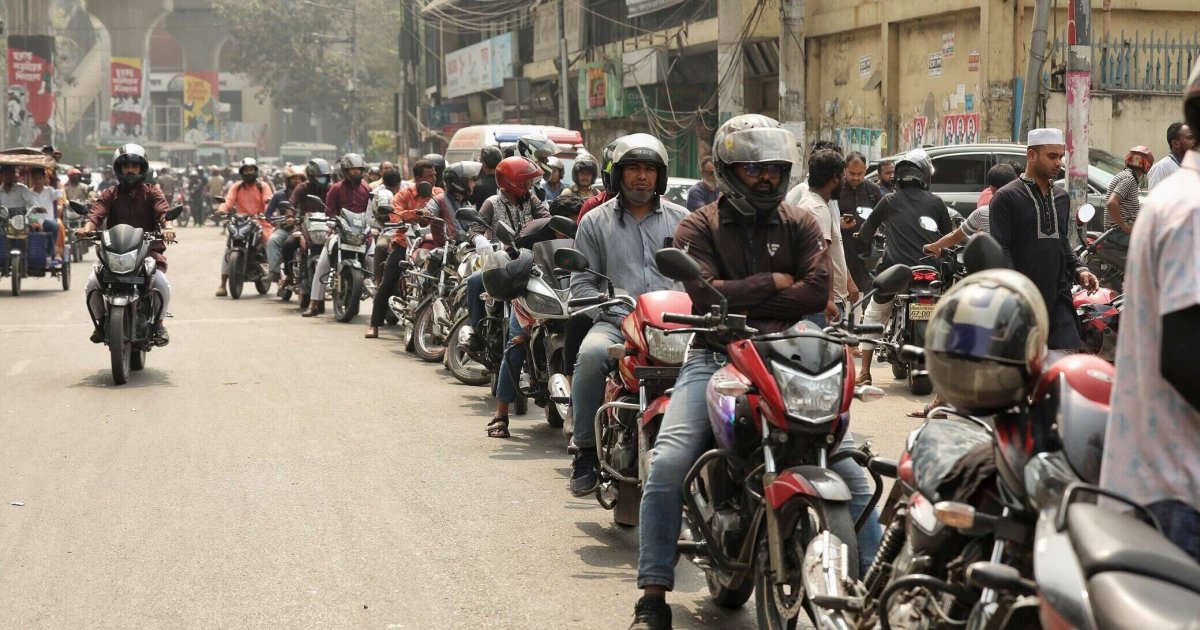
Yet at the retail level, pumps are running dry and transport operators are cancelling trips. The official explanation attributes the disruption to panic buying. Consumers, fearing future shortages, have begun purchasing more fuel than usual, exhausting local stocks faster than expected.
Panic buying is indeed a familiar phenomenon in times of uncertainty. However, panic does not emerge from nowhere. It usually grows in the gaps between public assurances and lived experience.
When citizens see long queues at filling stations, closed pumps or transport cancellations, confidence in official claims inevitably weakens. In such an atmosphere, rumours travel faster than tankers.
Transport operators, for their part, appear to be navigating the situation with a mixture of caution and opportunism.
Reduced fuel availability provides a convenient justification for limiting services or adjusting ticket prices. Whether these decisions are purely defensive or partly strategic is difficult to determine. What is certain is that passengers bear the immediate burden. For many families planning their annual journey home, the cost of travel has quietly risen, even when official fare structures remain unchanged.
The deeper issue, however, extends far beyond seasonal transport disruption. It concerns the long-term trajectory of Bangladesh’s energy policy.
The energy mix
For years, the country has walked a narrow path between rising energy demand and limited domestic supply. Rapid economic growth, urbanization, and industrial expansion have significantly increased the need for electricity and fuel. Instead of expanding domestic energy exploration at a comparable pace, policy-makers have often chosen the quicker route of imports.
In the short term, importing LNG or petroleum can appear efficient. It allows power plants to operate without waiting for lengthy exploration projects. It satisfies industrial demand and avoids politically sensitive power shortages.
Yet every imported unit of energy also increases the country’s exposure to international price volatility. When global markets become unstable, the national economy inevitably absorbs the shock.
This vulnerability has become increasingly visible in recent years. Currency pressure, rising global energy prices, and infrastructure constraints have made it difficult to import fuel at the scale required. LNG cargoes have occasionally been delayed or reduced due to financial considerations. Subsidy burdens on the national budget have grown steadily. What was once presented as a flexible energy strategy now resembles a costly dependency.
The irony is that Bangladesh is not entirely devoid of domestic energy potential. Significant gas reserves have historically supported the country’s power sector, and further exploration opportunities remain both onshore and offshore.
For decades, discussions about expanding exploration capacity have circulated in policy circles. National institutions tasked with exploration have repeatedly been promised investment, technological support, and institutional strengthening. Yet progress has been slow and uneven.
Part of the problem lies in the political economy of energy policy. Import-based solutions often deliver quicker visible results than long-term exploration projects. Signing import agreements or constructing LNG terminals can demonstrate immediate action.
Drilling wells and conducting geological surveys require patience, technical expertise, and sustained commitment. In a policy environment that frequently prioritizes short-term stability over structural reform, the latter tends to receive less attention.
The promise of renewables
Renewable energy represents another underutilized opportunity. Bangladesh enjoys substantial solar potential, particularly for rooftop installations in urban and industrial areas. The cost of solar technology has fallen dramatically worldwide, making it increasingly viable for developing economies.
Several neighbouring countries have already accelerated their renewable expansion, reducing their reliance on fossil fuels and insulating themselves from global price shocks.
In Bangladesh, interest in solar power has grown among households and small businesses seeking relief from rising electricity bills. Yet, large-scale integration into the national energy system has progressed slowly.
Infrastructure limitations, regulatory uncertainties, and bureaucratic inertia continue to impede rapid expansion. Renewable projects often move through lengthy approval processes, while grid modernization struggles to keep pace with new capacity.
This slow transition carries a hidden cost. Every delay in developing renewable infrastructure prolongs dependence on imported fuels. Every postponed exploration project increases the likelihood that future energy demand will be met through external sources. Over time, these incremental decisions accumulate into a strategic vulnerability.
Where we are now
The current episode at bus terminals therefore serves as a symbolic warning. A rumour of fuel shortage is enough to disrupt transport networks, trigger panic buying, and expose institutional fragility. If such disruptions can occur during a temporary geopolitical shock, one can only imagine the consequences of a prolonged global energy crisis.
Energy security is not merely about maintaining sufficient reserves or ensuring the arrival of fuel shipments. It is about building a resilient system capable of withstanding external shocks.
Such resilience requires diversification of supply sources, expansion of domestic production, and rapid development of renewable alternatives. It also requires institutional coordination that prevents panic from spreading faster than information.
Bangladesh has reached a point where incremental adjustments may no longer be enough. The country’s growing economy demands a more comprehensive transformation of its energy strategy.
Domestic gas exploration must be revitalized with modern technology and adequate investment. Renewable energy capacity must expand beyond symbolic projects into a significant component of the national grid. Infrastructure must be modernized to reduce transmission losses and increase efficiency.
Equally important is the need for transparency and public trust. When conflicting signals emerge between official statements and everyday experiences, citizens inevitably rely on speculation. In the energy sector, where markets react quickly to uncertainty, maintaining credibility becomes essential.
The crowded ticket counters and anxious passengers attempting to return home for Eid offer a snapshot of a larger structural challenge. Bangladesh’s energy system has grown increasingly complex, interconnected with global markets and vulnerable to distant conflicts. Each tanker that docks at port buys the country a little more time, but it does not solve the underlying dilemma.
The real question is not whether there is a fuel shortage today. The more pressing question is whether the country is prepared for the energy realities of tomorrow. Until that question receives a convincing answer, the fear of crisis will continue to travel faster than the fuel itself.
HM Nazmul Alam is an academic, journalist, and political analyst based in Dhaka, Bangladesh. Currently he teaches at IUBAT.
