


India’s north-eastern state of Mizoram and the Chin State of northern Myanmar have a history of tribal unrest, armed rebellion and secessionism.
While the Mizo insurgency was curbed due to New Delhi’s decision to grant the Mizos autonomy within the Indian Union, the Chin insurgency continues in Myanmar because of Yangon’s reluctance to address the Chin’s grievances and grant them a measure of autonomy.


Although the Mizos are well integrated into India, with many holding high positions in government due to their proficiency in English, complications arise in their relations with the Chin across the border in Myanmar.
The two are kindred tribes, sharing language and culture. It was the British rulers who divided them by drawing a line between “India” and “Burma” (now Myanmar).
Since the Chin are fighting the Myanmar junta, they receive support from the Mizos on the Indian side. People, insurgents, drugs and arms move across the border despite the mountainous and forested terrain.
When waters are troubled anywhere, interested parties – including foreign countries, intelligence agencies, and arms and drug smugglers – move in to exploit the situation. The Mizo-Chin area is no exception.

Currently, the contest appears to involve Americans and Ukrainians, reportedly supporting the Chin against the Myanmar military junta, which is backed by China and Russia.
India is neutral in the conflict in Myanmar, but does little to curb activities along its border. It is in India’s interest that the region is pacified.
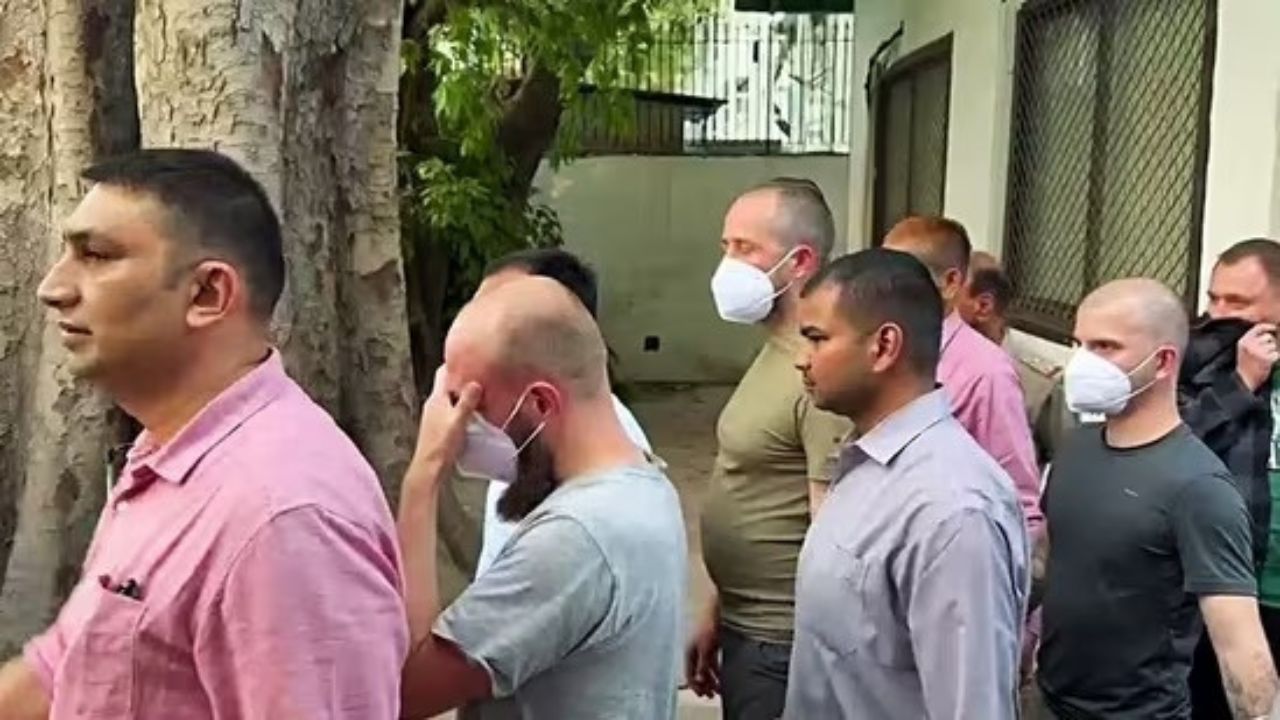
The foreign element in the recent imbroglio became public in March when a US citizen and six Ukrainians were arrested by India’s National Investigation Agency (NIA) for illegally crossing into Myanmar via Mizoram, allegedly to train armed ethnic groups in weapons handling and drone warfare.
The group had been under surveillance for several months. The accused were identified as US national Matthew Aaron Van Dyke and Ukrainians Hurba Petro, Slyviak Taras, Ivan Sukmanovskyi, Stefankiv Marian, Honcharuk Maksim and Kaminskyi Viktor. They were reportedly arrested in Delhi, Lucknow and Kolkata airports on the night of March 13.
Van Dyke is described as a “media personality” based in Ukraine. He has openly stated that he runs covert operations in various countries to effect regime change. In one post, he said: “To the leaders of Venezuela, Burma (Myanmar), Iran and other authoritarian regimes – we are coming for you. Russia, we are coming for you as well.”
While the US Embassy in Delhi declined to comment, the Ukrainian government said the detainees were innocent and demanded consular access. It also blamed Russia for the arrests.
The foreigners were detained for entering restricted “no-go” areas such as Mizoram without a Protected Area Permit (PAP). However, Ukraine’s Ministry of Foreign Affairs suggested it may have been an “unintentional violation.”
The accused were remanded in custody until March 27 under Section 18 of the Unlawful Activities (Prevention) Act.
In December 2024, India’s Home Ministry had alerted the north-eastern states of Mizoram, Manipur and Nagaland to monitor foreign visitors closely.
In March 2025, Mizoram Chief Minister Lalduhoma told the state assembly: “We have specific intelligence that Ukraine war veterans travelled to Myanmar’s Chin State via Mizoram to train rebel outfits.”
He added that although nearly 2,000 visitors from Western countries were registered between June and December 2024, very few tourists were seen in Aizawl, raising suspicions that many had entered prohibited areas.
Peter Thang
A report in The Quint by VK Shashikumar identified a key figure in the Chin movement. Peter Thang is the vice-president of the Chin National Defence Force (CNDF), the armed wing of the Chin National Organisation (CNO), established in 2021.
Before the 2021 military coup in Myanmar, Thang ran a travel agency in Yangon. He is now alleged to be involved in drug trafficking, arms procurement and drone smuggling operations linked to the CNDF.
Both the CNDF and the Chin National Army (CNA) operate under the umbrella of the Chin Brotherhood. American missionary networks reportedly provide support, while the armed struggle is believed to be financed largely through narcotics.
American connection
Matthew Van Dyke, the US national, was born in Baltimore. He holds a Master’s degree in Security Studies from Georgetown University and another in War Studies from King’s College London.
He is the founder of Sons of Liberty International (SOLI), a non-profit security contracting organisation that provides military training to forces opposing authoritarian regimes.
Van Dyke fought in Libya’s 2011 civil war and was held for six months as a prisoner in Muammar Gaddafi’s prisons. He later filmed a documentary in Syria and founded SOLI after ISIS killed journalists James Foley and Steven Sotloff.
He has trained Iraqi Christians against ISIS and Ukrainian civilians against Russia since 2022. His operations have spanned Libya, Syria, Iraq, Afghanistan, Ukraine, the Philippines, Venezuela and Myanmar.
NIA officials told the court that the suspects had been tracked in the northeast for months. Investigators believe the group made repeated visits since 2024. Eight more Ukrainians from a group of 14 who entered India on tourist visas remain untraceable.
According to investigators, on February 12 and 20, 2026, the Kachin Independence Army (KIA) and allied People’s Defence Forces (PDF) used drones to attack Myitkyina airport, reportedly damaging a passenger aircraft. The airport was officially shut on February 26.
Sources said Van Dyke admitted to supplying dismantled drones to the KIA and PDF to strengthen their military capabilities.
Russian tip-off
Multiple sources told The Quint that Russian intelligence alerted Indian authorities. Russia and China are key backers of Myanmar’s military junta, supplying weapons and exerting influence over ethnic armed groups.
Bangladesh angle
Ahead of Bangladesh’s January 2024 elections, then prime minister Sheikh Hasina warned that a “white man” had proposed supporting her return to power in exchange for allowing foreign bases in Bangladesh.
She also expressed concern about a possible plan to create a separate Christian state involving parts of Chattogram and Myanmar.
Some of India’s north-eastern states—excluding Assam, Manipur and Tripura—have Christian-majority populations, raising speculation about their potential inclusion in such a proposal.
Humanitarian corridor
During the interim government period, the US proposed a “humanitarian corridor” between Myanmar and Bangladesh to facilitate aid to Rohingya populations.
The idea, reportedly supported by Chief Adviser Muhammad Yunus, was opposed by sections of the Bangladesh media and armed forces over concerns it could enable infiltration.
