

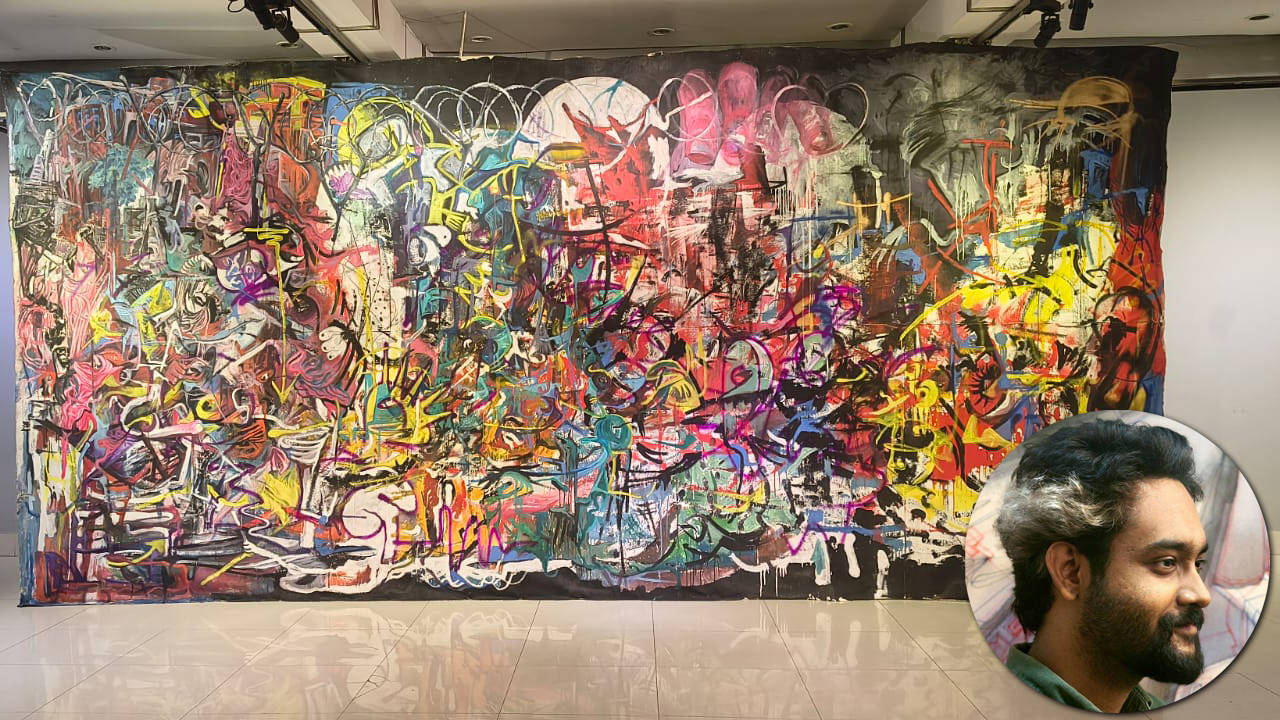
In the ongoing exhibition ‘A Shared Condition’, perception itself becomes unstable, as images refuse fixed meaning and instead shift with the viewer’s act of witnessing and exploring, where familiar forms begin to surface within abstraction in ways that constantly rearrange interpretation. This perceptual logic, often understood through Pareidolia, runs through the practice of multidisciplinary artist Mubtasim Alvee, shaping a visual language where nothing remains fully resolved.
Being held at Alliance Française de Dhaka (AFD) in Dhanmondi from May 8 to 16, 2026, the exhibition marked Alvee’s first solo presentation and brought together works created between 2025 and 2026 across acrylic, spray, pastel, printmaking and digital media.

Over its duration, it also unfolded through a parallel programme of discussions, workshops, screenings, performance and music, with contributions from platforms including Bhabachakra, Syllabaad Collective, Charukola Animation Society, Dhaka Comics, Footprint Film Production, Street Spirits and Siliconinja.

The programmes included panel discussions on May 9 and 14, a graffiti workshop on May 10, screenings of Delupi on May 11 and 12, a rhythm and music workshop on May 13, a post dramatic theatre performance on May 15, and a closing discussion and concert on May 16.

TIMES of Bangladesh visited the exhibition on Thursday night during its final stretch, where the artist was seen moving between viewers, informally engaging in conversations around the works and the ideas behind them. Speaking to ToB, Alvee said his engagement with the idea of Pareidolia began in 2024 and eventually evolved into a central part of his visual language.

“I wanted viewers to interpret the term in their own way through the paintings,” he said. “Many people told me they could not completely understand the works, but that was also part of the intention.”
“I wanted them to create meanings freely and independently. Through that process, a kind of collective connectedness emerged,” Alvee told TIMES.
Across the works, Alvee constructs a visual field where abstraction never fully settles. Forms appear and dissolve in cycles, echoing unstable memory and layered psychological conditions shaped by both individual and collective experience.
Rather than presenting singular narratives, the paintings remain open ended, allowing viewers to navigate their own emotional and perceptual responses inside the crowded visual landscapes.
Alvee, currently pursuing his MFA in Painting at the Faculty of Fine Arts, Dhaka University, frames his practice around shared perception and collaborative structures of experience. Beyond his studio practice, he has remained closely connected to interdisciplinary cultural initiatives and collective learning environments. Designing the poster of the acclaimed Bangladeshi film ‘Delupi’ has been one of his works.
He is also associated with Syllabaad Collective and the Charukola Animation Society, reflecting his engagement with collaborative modes of making, pedagogy and artistic exchange.
Within the exhibition, Pareidolia functions not merely as a visual device but as a framework through which meaning itself becomes unstable and participatory. Abstraction is completed through the viewer’s recognition, where memory, context and attention continuously reshape what is being seen.
Curator Mustafa Zaman situates Alvee’s work within the density of urban experience, describing the artist’s visual language as one shaped by crowding, movement and layered social realities. Referring to works such as 36 No. Bus, Zaman notes how ordinary city experiences transform into rhythmic visual orchestrations where bodies, systems and emotional residues overlap within the same pictorial field.
The collaborative nature of A Shared Condition also extended beyond the gallery walls. Through discussions, workshops, screenings, music and performance, the exhibition consistently resisted the idea of the isolated solo presentation. Instead, it evolved into a shared cultural environment where dialogue, participation and interpretation became inseparable from the artworks themselves.
At the end of the exhibition, it seems that it carried the feeling of something still emotionally active even as it approached its conclusion. In that sense, ‘A Shared Condition’ leaves behind not a fixed statement, but an unfinished field of perception where meaning continues to shift, dissolve and re-emerge through every act of looking.
