

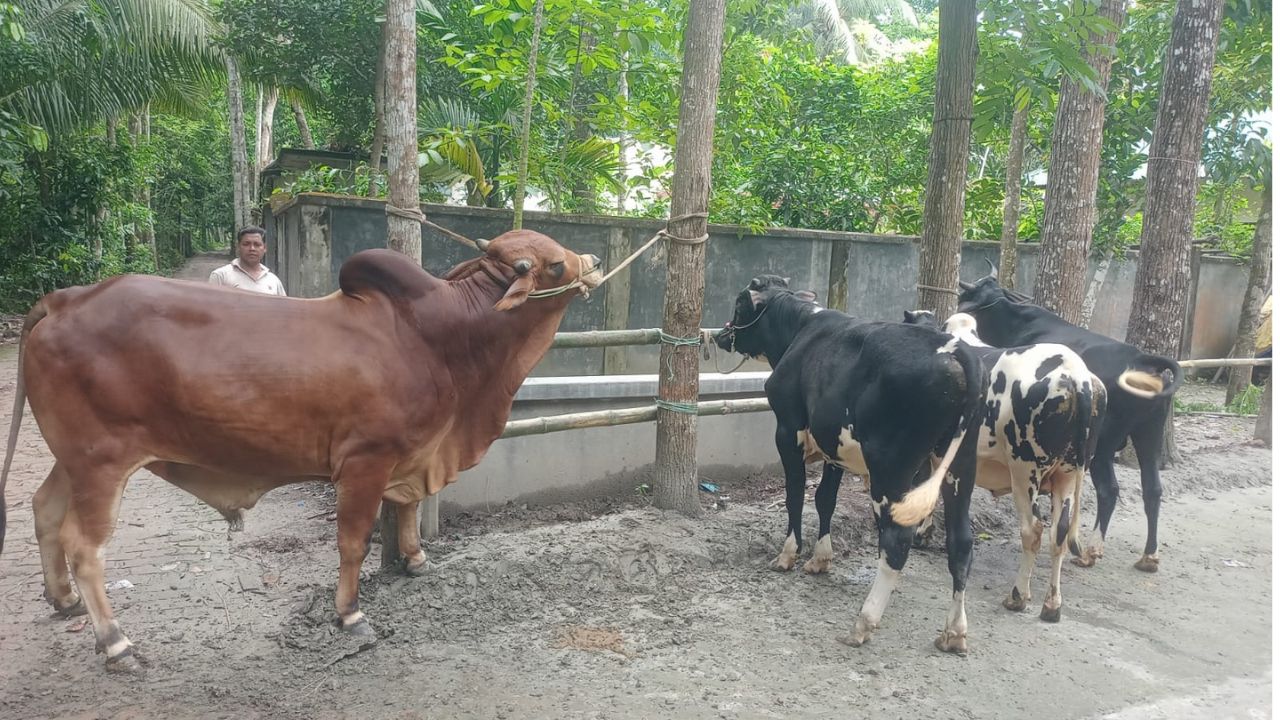
Barishal division is expected to have a surplus of nearly 68,000 sacrificial animals ahead of Eid-ul-Azha, with officials saying local production will be sufficient to meet the entire regional demand.
According to the Department of Livestock Services (DLS), around 4,68,445 sacrificial animals are currently available across the division’s six districts against an estimated demand of 4,00,783 animals. The figures indicate a surplus of 67,662 animals this year.

The animals have been prepared by 3,915 small and large-scale farmers across the division, according to data from the Barishal divisional office of the livestock department.

The available stock includes 2,00,083 bulls, 68,278 oxen, 98,005 buffaloes, 1,19,890 goats and 150 other animals.

District-wise data also show supply exceeding demand in almost every district.

In Barishal district, demand has been estimated at 1,26,579 animals against an available stock of 1,29,044. Patuakhali has 1,33,718 animals against a demand of 1,11,874, while Jhalakathi has prepared 30,588 animals against a projected demand of 30,028.
In Barguna, 43,426 animals are available against a demand of 30,182. Bhola has a stock of 1,03,017 animals compared with an estimated demand of 80,743, while Pirojpur has prepared 28,652 animals against a demand of 21,577.
Barishal Divisional Livestock Office Director Md Mahfuzul Haque said local production had increased significantly as many rural families were now rearing cattle and goats on a small scale.
“We hope there will be no need to depend on imported animals this year as local farms are capable of meeting the entire demand,” he said.
Farmers, however, warned that higher feed and transport costs may push cattle prices up this year.
MEP Agro Farm supervisor Rafiur Rahman said the cost of animal feed and transportation had increased sharply compared with last year, raising concerns over higher market prices.
“Many farmers have already started selling cattle directly from farms, allowing buyers to purchase animals at slightly lower prices than in traditional cattle markets,” he said.
Barishal Saad Saeed Agro Farm owner Saeed Bin Miraj said many buyers were now preferring to purchase cattle directly from farms to avoid additional expenses and complications at cattle markets.
“Buying cattle from markets often involves brokers, taxes and transport costs. Due to the fuel crisis, transportation expenses may rise further this year,” he said.
He added that many agro farms were now offering home delivery services through their own transport arrangements.
Local farmer Nasir Uddin from the Tiyakhali area in Barishal city said cattle rearing costs had increased significantly because of rising feed prices.
“We will fix prices considering the market situation and production costs. It is likely that cattle prices will be higher than last year,” he said.
Another farmer, Liton, said many cattle had already been sold directly from farms ahead of Eid.
“The remaining cattle will be taken to markets, but rearing expenses have risen sharply this year. Prices are being set accordingly,” he said.
Meanwhile, the administration has strengthened monitoring to prevent artificial cattle fattening ahead of Eid. The livestock department said veterinary medical teams would remain active in markets to inspect animal health and oversee trading activities.
