

Sheikh Musa was a son of a noble family from Sindh. He was well-known for both his character and his knowledge. Spiritual thirst became the most important thing for his descendant, Sheikh Khijir. Because of his intense curiosity, he traveled from the East to the West. His ancestors had come from Arabia. So, he also spent some time with the specific Arab clan from which his family originated. Finally, he settled in a place called Nagaur, near Ajmer. He regularly attended the gatherings of Sheikh Hamiduddin, a Sufi saint of the Chishtia order. In the family of this Sheikh Khijir, Sheikh Mubarak was born in 911 Hijri. He was the son of Sheikh Khijir.
From just four years of age, Sheikh Mubarak started showing the quality of his blood. It was clear through his talent and thinking power. He inherited the inner thirst from his father. He traveled no less than his father to satisfy it. He was also heavily criticized for his Sufi mindset. Even so, he received the patronage of the Mughal ruler Babur as a recognition of his scholarship. Babur had just established his rule in India at that time. Much later, in the month of Muharram in 950 Hijri, he settled permanently near Charbagh Villa in Agra. That Charbagh Villa was also built by Babur. Anyway, two sons were born to him there. The first son, Abul Faiz, was a poet and a mathematician. With his own talent, he had earned a place in the favor of the third Mughal Emperor, Akbar, long ago. However, the younger brother surpassed even him in wisdom and influence. His name is highly celebrated not just in the Mughal era, but in the entire history of intellectual practice in India—Abul Fazl.
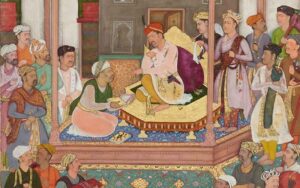
Father Sheikh Mubarak played a huge role in shaping the personality and scholarly life of Abul Fazl. From his childhood, Abul Fazl studied under his father’s guidance with great enthusiasm and focus. Sheikh Mubarak faced persecution at the hands of court scholars for supporting the Mahdi movement. At that time, the Hijri millennium was changing. In the late 15th century, Syed Muhammad Jaunpuri claimed to be the Imam Mahdi and received a great response. He called people away from growing materialism and toward the path of spiritual progress.
Due to various existing instabilities, the Mahdi movement gradually gained popularity. During any millennium change, special movements to change the existing system are seen in different religions and societies. This concept is known as millenarianism. For example, a major reason for the rush of Western crowds toward Jerusalem before the Crusades was the millennium change in the Christian calendar. It was the expected time for Jesus to reappear—meaning, the millennium belief. In the context of India, it is not impossible that this change of the Hijri millennium acted as a sort of fuel behind the Mahdi movement. It is also not impossible that it played a role in shaping the psychology behind Akbar’s later establishment of Din-i Ilahi.
Anyway, the instability of that belief left a deep mark on the mind of the young Abul Fazl. Under this influence, he studied religion, philosophy, and other subjects, which made him open-minded. His ability to speak and write Arabic at just five years old, and his mental maturity at fifteen, amazed his contemporaries. Abul Fazl was deeply focused on his studies. He felt that staying at the royal court created attachments. For this reason, he preferred a simple life free of attachments. Because he kept himself hidden, no one noticed him in the beginning. Finally, his elder brother Abul Faiz cleared the path for him to enter the court. Near the end of 981 Hijri, around 1574 AD, Abul Fazl appeared before Emperor Akbar along with his elder brother. That appearance changed everything. Akbar was truly amazed by his talent. It was as if a whole ocean had appeared before a diver who was searching for gems.
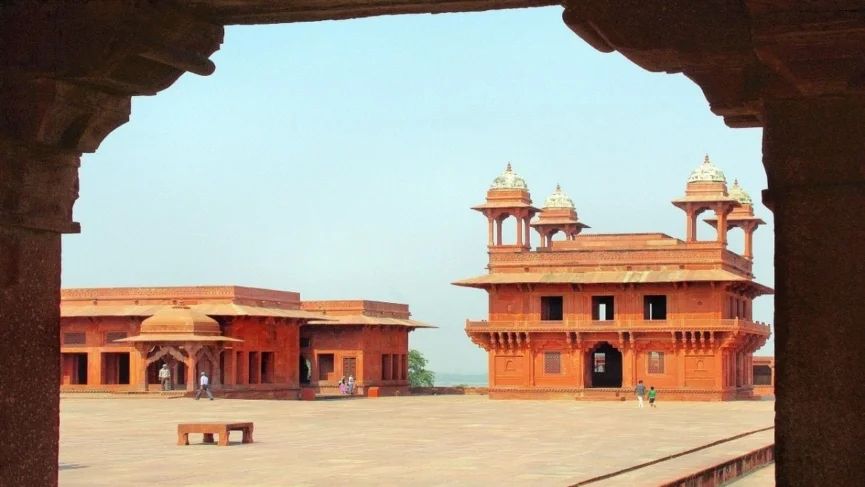
From 1579, the relationship between Emperor Akbar and the two brothers—Abul Faiz and Abul Fazl—began to grow closer. The elder brother’s position with Akbar becomes clear when we see that he was appointed as the tutor to Prince Murad. Of course, both Faiz and Fazl had joined the army. Working in different departments opened up opportunities for new honors. Both brothers lived in Fatehpur Sikri. Within about two years, the elder brother was appointed as the Sadr (chief administrator) of Agra, Kalpi, and Kalinjar. One of his main tasks was to bring tax-free lands under government control. On the other hand, Abul Fazl was appointed as a Mansabdar of one thousand in 1585. A Mansabdar of one thousand meant a commander of one thousand horsemen. The very next year, he was appointed as the Diwan (finance minister) of the Delhi province. In late 1589, Abul Fazl’s mother passed away. The book Akbarnama was dedicated to her memory. The Emperor went to comfort him and said, “If only the people of this world could live forever!”
By this time, religious matters had progressed much further. Akbar introduced a new belief system called ‘Din-i Ilahi’. Its main features were belief in one God and recognizing Akbar as His representative on earth. However, the tradition of considering rulers as divine figures is quite ancient in various cultures. Islamic rituals and worship decreased in the court. A new calendar system was introduced under the name ‘Tarikh-i Ilahi’. Later, the Bengali calendar was born from this Tarikh-i Ilahi. Anyway, the nobles (Amirs and Umrahs) of the court were unhappy to see Abul Fazl’s influence over Akbar. Prince Salim (later Emperor Jahangir) was one of those unhappy people. His anger was so deep that Salim began to think Abul Fazl was the main obstacle to fulfilling all his plans. He even succeeded in getting him into trouble a few times. Once or twice, Abul Fazl’s relationship with Emperor Akbar worsened, but that was only temporary.
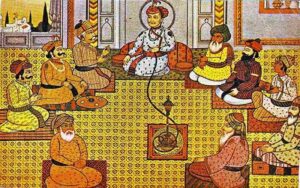
At that time, there was a great gathering of scholars at Akbar’s court. Badayuni, Naqib Khan, Sheikh Sultan, Haji Ibrahim, Sheikh Munawwar, and Faizi (Abul Faiz). Each was working in his own way to translate books on history, science, Sanskrit, and Hindi into the Persian language. Faizi was busy translating the famous mathematics book Lilavati. Meanwhile, Abul Fazl translated the Arabic books Kalila wa Dimna and Iyar-i Danish into Persian. He also participated in the translation of the Mahabharata and the Tarikh-i Alfi. Around the middle of 1592 (1000 Hijri), Akbar promoted Abul Fazl to a Mansabdar of two thousand. Through this, he began to be counted among the ‘Umaraye Kibar’ or the chief nobles of the court.

Sheikh Mubarak died in 1593. Just two years later, Faizi passed away at the age of 50. These two consecutive blows left Abul Fazl heartbroken. Even the Emperor himself was overwhelmed with grief. How deeply Abul Fazl loved his brother is clear from the Akbarnama and Ain-i-Akbari. Despite his extremely busy schedule, two years after his brother’s death, he collected and compiled Faizi’s scattered poems in a collection called Markaz al-Adwar. Moreover, Abul Fazl quoted numerous writings of Faizi in the Akbarnama. Around the same time, he was promoted to the position of a commander of 2,500 horsemen. He also completed writing the Ain-i-Akbari.
In the 43rd year of Akbar’s reign, Abul Fazl took part in active field duty for the first time. Murad was unable to run the administration properly in the Deccan. The worried Emperor sent Abul Fazl to bring the prince back to the capital. Through a long series of dramatic events, Abul Fazl’s loyalty and dedication were proven. In 1008 Hijri, when Abul Fazl met Emperor Akbar near Bilagarh, the Emperor welcomed him with poetry. He was promoted to a Mansabdar of four thousand. Around the same time, when trouble broke out again in the Deccan, there was a need to go back there. Leaving Prince Daniyal in Burhanpur, Akbar returned to Agra. Abul Fazl was then one of the Emperor’s most trusted allies.
It was the 47th year of Akbar’s reign. Signs of rebellion were beginning to appear in Prince Salim. The worried Akbar summoned his only trusted confidant, Abul Fazl. He advised him to leave his army behind in the Deccan. Prince Salim was not angry with Abul Fazl as a person. Rather, he was eager to remove Akbar’s main pillar of support. Killing the unprotected Abul Fazl was equivalent to breaking Akbar’s right hand.
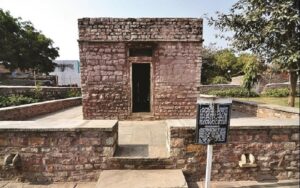
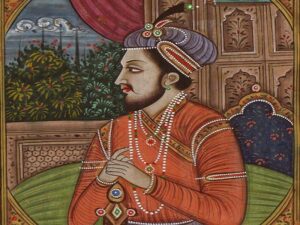 Salim requested the Orchha Bundela chief, Raja Bir Singh, to kill Abul Fazl when he passed through his area. On August 12, 1602 AD (corresponding to 1011 Hijri), six kros away from Narwar and one kros away from Saraibar, Bir Singh’s soldiers found Abul Fazl. Although his companions advised him to flee, Abul Fazl considered it insulting for himself. He managed to survive bravely for a very short time. Then, he collapsed to the ground from a spear strike by a foot soldier.
In this way, Abul Fazl became a victim of the strained relationship between the father and Salim. Bir Singh cut off his head and sent it to Salim in Allahabad. No one dared to break the news of Abul Fazl’s death to Emperor Akbar. Finally, when his Vakil (lawyer/representative) appeared with a blue handkerchief tied to his hand, Akbar understood the matter. It was a tradition of the Timurid dynasty that if any of the princes died, it could not be announced in the court in plain language. When the Vakil appeared with a blue handkerchief tied to his wrist, everyone would understand. Whatever the case, Akbar mourned and lamented the news of Abul Fazl’s death even more than the loss of a son.
As a writer, Abul Fazl is unique. He had his own style in the strength of his words, the structure of his sentences, the skill of logical word choice, and the use of punctuation. As a result, although his work was read everywhere, it was impossible to copy his writing style. In that era, Abul Fazl’s influence was also extraordinary. Although many questions were raised about his religious beliefs, most of them were just over-enthusiastic propaganda. Anyone can understand this by reading the introduction to the Akbarnama.
Among the books written by Abul Fazl, the main ones are Akbarnama, Maktubat-i Allami, and Iyar-i Danish. The first one gives an overall idea of Emperor Akbar’s reign and administration system; the second one is a collection of letters written by Abul Fazl to various rulers and prominent people; and the last one is a translation. Apart from these, Risala-i Munajat and Jami-ul-Lughat are also his writings. We can end with a piece of writing by Abul Fazl, which was carved in a temple in Kashmir:
“O Allah, in every temple I see people searching for You. In every language I hear Your praise. Both monotheists and polytheists are Your followers. If it is a mosque, people recite Darood and prayers; and if it is a church, they ring the bell out of love for You. A million lovers’ hearts are pierced by the arrow of Your grief; the world is lost in You, yet You remain hidden from sight. Therefore, sometimes in a monastery, sometimes in a mosque, and sometimes in a temple, I search for You.”
