

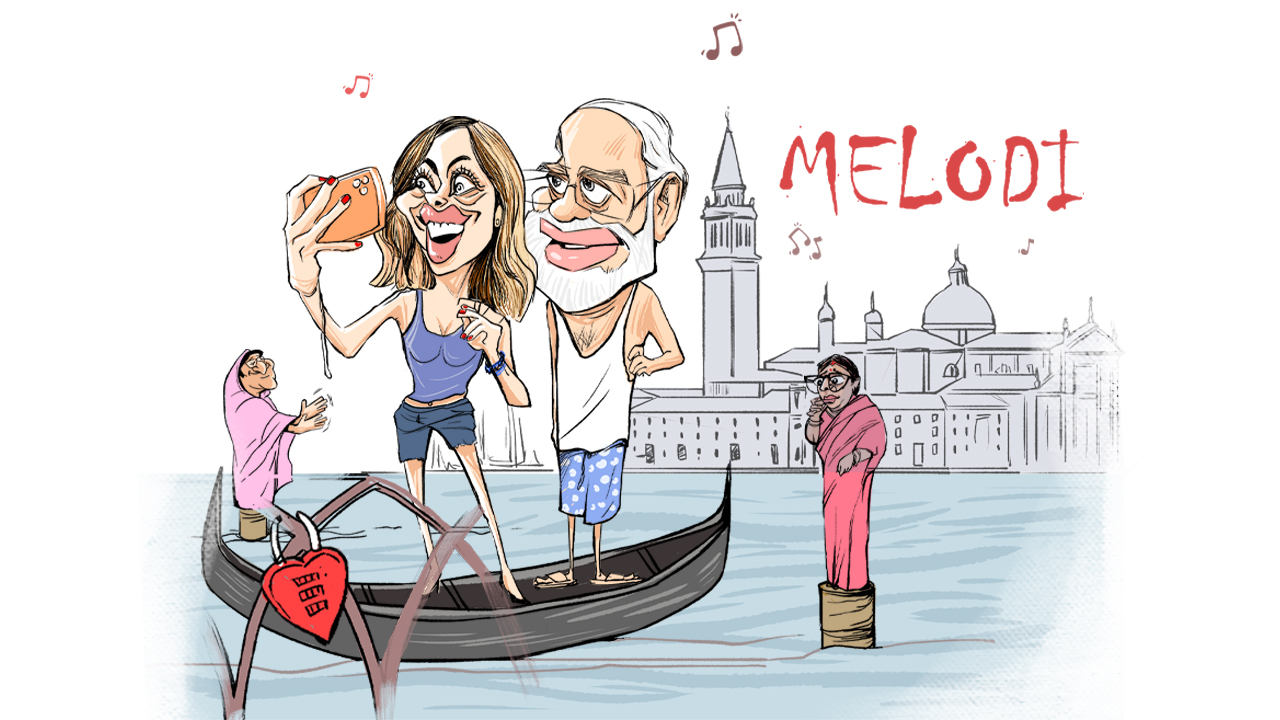
When Indian Prime Minister Narendra Modi touched down in Rome after a gruelling five-nation tour, he didn’t just head to a stuffy bilateral meeting; instead, he stepped right onto the set of a meticulously lit, prime-time geopolitical romance.
There, bathed in the moody, ancient glow of the Colosseum, was Italian Prime Minister Giorgia Meloni, phone raised at the perfect forty-five-degree angle to drop a selfie that shook social media like a surprise pop album, captioned, “Welcome my friend to Rome. Hello from the Melodi Team.”

Once upon a time, the word melody referred to a sweet, harmonious sequence of musical notes that brought joy to the human soul, but in the hyper-online, brain-rotted era of modern statecraft, it has been rebranded as the ultimate corporate shipping name for two G20 leaders Meloni and Modi.


To the untrained eye, these recurring Melodi selfies – which first broke the internet at the 2023 Dubai climate summit – look like cheap, light-hearted food for netizen memes or a classic enemies-to-allies rom-com playing out on your feed.

However, don’t let the soft-focus filters fool you, because this viral chemistry is actually the ultimate psychological thirst-trap designed to mask dry, cold, and calculated geopolitical manoeuvres.

While the internet is busy spamming heart-eye emojis and trending the hashtag Global Power Couple, behind the curtain, spreadsheets are sweating and billions of dollars are being aggressively counted under the Joint Strategic Action Plan 2025–2029, a title that sounds less like a marriage vow and more like a hostile corporate restructuring.

If Melodi is a relationship, it is an incredibly lucrative situationship built on a staggering $16.77 billion bilateral trade portfolio and a modest $3.66 billion dowry of Italian investments in India accumulated over the last quarter-century.
Ultimately, while the public is busy fuelling the comment sections with fire emojis, grey-faced bureaucrats in the commerce ministries of New Delhi and Rome are quietly rubbing their hands together, plotting a seamless, heavily armed economic ring stretching all the way from the Indo-Pacific to the Mediterranean.
It turns out the absolute best way to sign massive defence contracts and monopolise maritime trade routes is simply to look adorable on Instagram, proving that modern global problems require modern, highly photogenic solutions.

There is, of course, a fascinating psychological pathology behind why netizens are so utterly feral for this specific pairing.
On one side of the frame, you have Giorgia Meloni, Italy’s first female and youngest Prime Minister, a dynamic European firebrand who shattered glass ceilings just to hold a smartphone at an optimal angle. On the other side sits Narendra Modi, the ultimate enigmatic “married bachelor” of Indian politics.
Having walked away from domestic life shortly after his wedding to dedicate himself as a full-time ascetic preacher for the RSS, Modi has kept his personal life locked in a vault of national intrigue for decades, leaving his marriage to Jashodaben un-divorced but entirely under wraps.
Naturally, when the internet juxtaposes this ultra-conservative political monk with Europe’s premier right-wing heroine, the collective imagination of two nations completely short-circuits.

Within hours of the Colosseum drop, the photo raked in over 1.5 million views, prompting over-enthusiastic Indian netizens to officially induct a foreign G7 leader into their family WhatsApp groups by affectionately christening her “Bhabiji” – because nothing says international relations quite like assigning traditional sister-in-law duties to a European head of state over morning “Good Morning” flower memes.
The supreme art of modern politics and diplomacy lies in narrative control. Just 24 hours before his high-profile visit to Rome, the Indian Prime Minister was weathering a storm of social media criticism for bypassing journalist questions in Norway.
Yet, in the digital age, a single, well-timed selfie is all it takes to shift the paradigm. That lone, smiling picture captured in Rome instantly wiped the negative commentary from the timeline, replacing it with a deluge of hearts, fire emojis, and the viral hashtag #Melodi.

This digital shift beautifully mirrors a literary contrast from the past. In his poem ‘To Europe’, the iconic poet Sukanta Bhattacharya characterised Italy as Snigdha, serene and gentle, writing, “There now May is a snow-melting day, here the fire-drenched Baishakh is sleepless.”
Today, Narendra Modi embodies that “fire-drenched Baishakh” of Indian politics, acting as the personification of a fierce, relentless political storm and campaign engine. On the flip side, Giorgia Meloni represents the crisp, vibrant spring of Europe – lively, camera-savvy, and fiercely media-smart.
Thank you for the gift pic.twitter.com/7ePxbJwPbA
— Giorgia Meloni (@GiorgiaMeloni) May 20, 2026
The convergence of these two distinct political forces has created one of the most viral duos in modern international relations. In the lexicon of communication science, this phenomenon is defined as personalised political communication or image politics.
Modern state leaders no longer wish to appear as distant, untouchable bureaucrats; instead, they actively curate personas that are humane, relatable, and accessible. Consequently, contemporary diplomacy is no longer confined to the sterile prose of joint statements issued from air-conditioned, closed-door meeting rooms.
Instead, Instagram posts, curated hashtags, and viral selfies have become the softest, yet most potent, currency of global statecraft.
The author is a teacher and researcher on new media and political communication.
