

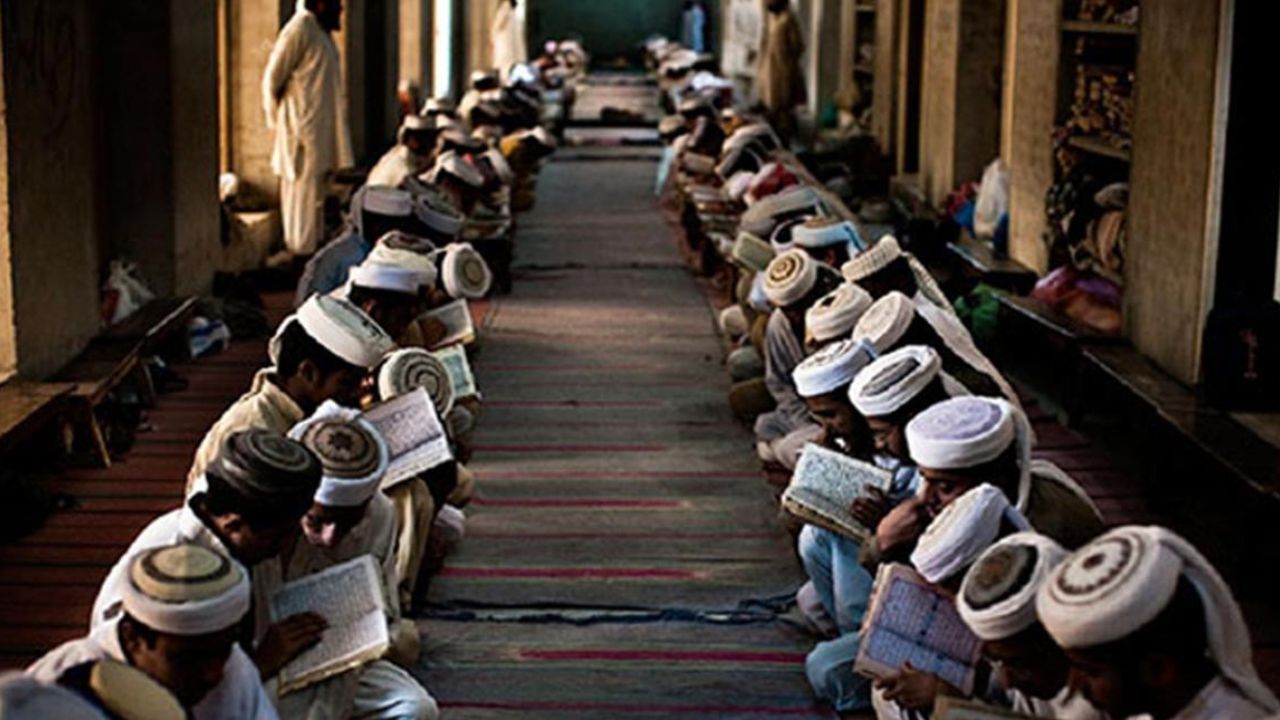
In Saturia union of Manikganj’s Saturia upazila, the decades-old Bichhat Government Primary School is experiencing a steady decline in student numbers, while a newly established Qawmi madrasa nearby continues to attract pupils.
The drop has reached a point where the school struggles to meet the government’s minimum enrolment requirements.

Reports of child abuse and sexual exploitation in madrasas continue to surface, yet these religious educational institutions are still seeing growth in student numbers. The increase in madrassa enrolment is occurring alongside a decline in government primary school attendance.

Qawmi madrassa teachers say that publicity surrounding abuse cases has had little impact on parental choices. In recent years, commercial-style English-medium madrasas have also flourished.

Habibullah Mizan, member of the management committee of Bichhat Government Primary School, told TIMES of Bangladesh, “My family owns the land for both the school and the madrasa. The primary school is government-run. Yet over the past few years, enrolment has fallen so sharply that many teachers have expressed frustration to me about the madrasa’s establishment.”

“Parents, on the other hand, blame primary school teachers for a lack of accountability,” he added.
A similar pattern has been observed in several primary schools and madrasas in Dhaka’s Basila and Mohammadpur areas, where primary school numbers have declined while madrasa enrolment has risen.
Education experts say financially constrained families, particularly women in low-income jobs and men in informal employment, are increasingly sending children to madrasas instead of primary schools. Many madrassas provide free boarding and meals, reducing household costs.
“Government primary schools suffer from a lack of supervision and limited facilities. Parents often have to pay for private tutoring outside the classroom. Those with limited means are opting for madrasas because they combine education with free accommodation and meals,” Manzoor Ahmed, emeritus professor at BRAC University, told TIMES.
Unlike government schools, which maintain detailed enrolment statistics, data on Qawmi madrasas is difficult to obtain. There is no central authority that tracks the number of students enrolled in these private religious institutions.
Leaders of the Qawmi Madrasa Teachers’ Association claim that enrolment has doubled or even tripled over the past decade, reflecting a growing trend despite ongoing concerns about student welfare.
Over one crore students enrolled in madrasas
Bangladesh’s madrasa education is primarily divided into two streams: Qawmi and Alia. While Alia madrasas operate under government supervision, Qawmi madrassas remain outside state control.
According to the main Qawmi regulatory body, Al-Haiatul Ulya Lil-Jamiatil Qawmia Bangladesh, there are at least 25,000 Qawmi madrasas nationwide operating privately. Over the past decade, the number of primary-level Qawmi madrasas has nearly doubled, and student enrolment has grown two- to threefold.
Current estimates suggest that Qawmi madrasas educate between 65 lakh to 70 lakh students, spanning from primary levels to those equivalent to a master’s degree. A decade ago, the sector is believed to have had 20 to 25 lakh students.
By contrast, official statistics indicate a 35 per cent drop in government primary school enrolment since 2015.
In the Alia stream, Md Abdur Rashid, deputy registrar (administration) of the Bangladesh Madrasa Education Board, said the board currently recognises 12,060 Alia madrasas at secondary and higher-secondary levels, accommodating roughly 24.5 lakh students from sixth grade through Alim (equivalent to HSC).
However, he noted that primary-level student numbers are harder to confirm. There are 7,451 registered Ibtedayi (primary) Alia madrasas, but an additional 7,000 to 8,000 operate outside official lists.
Board officials estimate that Alia and Nurani madrassas collectively educate at least 10 lakh students at the primary level.
The figures highlight a rapid growth in religious education, particularly in the Qawmi sector, even as government primary schools experience declining enrolment.
Enrolment rises on ‘low costs, moral appeal’
The growth of Qawmi madrasas is partly driven by lower costs for families, according to education officials and principals.
Ruhul Amin Sadi, principal of Atharul Ulum Adinabad Madrasa in Beanibazar, Sylhet, said, “Government schools lack supervision and can be costly. By contrast, most Qawmi madrasas provide free education.”
Sadi said changes to the national curriculum and public controversies have also influenced parents’ choices. “Stories circulated about Sharif and Sharifa, whether true or false, created negative reactions among the public. People’s interest in religious education has grown,” he added.
Teachers in the sector also credit the 2018 decision to equate the Qawmi Dawra-e-Hadith certificate with a master’s degree for increasing the appeal of this system.
Musleh Uddin Raju, senior vice-president of Befaqul Madarisil Arabia Bangladesh, the body overseeing Qawmi madrasas, said, “Madrasa teachers take their students’ education seriously. Teaching is also considered a form of worship, and the teachers themselves prepare the lessons.”
Mizanur Rahman Chowdhury, principal of Madrasa Dawatul Haq in Kapasia, Gazipur, added that many mainstream schools lack ethical and moral instruction, prompting parents to turn to Qawmi education.
However, not all agree with this “moral advantage” argument. Khairul Chowdhury, professor of sociology at Dhaka University, said, “Ethical and moral values exist within families and society, and across all religions. Madrasa teachers highlight moral education primarily for promotional purposes.”
Chowdhury noted that marginalisation of government primary schools in urban areas has facilitated the growth of English-medium and madrasa institutions. “The expansion of female labour and commercialisation has led to social exploitation. Working parents increasingly view madrasas as an alternative to boarding schools or day-care centres,” he added.
He also pointed out that while previously spinning and jute mills offered separate arrangements for workers’ children, the growth of the garment industry and other occupations has not been matched by government efforts to ensure children’s safety. “If the government wishes, it could take more responsibility for the protection of children from working families,” Chowdhury said.
Qawmi madrasas rely on donations
Despite economic pressures, support for religious education remains strong, according to teachers in Qawmi madrasas.
Deen Mohammad Ashraf, organisational secretary of the Qawmi Madrasa Teachers’ Association, told TIMES, “We rely entirely on donations and charitable contributions to pay teachers’ salaries, cover students’ education, and manage all operational costs.”
Mizanur Rahman Chowdhury, principal of Madrasa Dawatul Haq in Gazipur, said most Qawmi students come from economically disadvantaged families. “Providing three daily meals, round-the-clock supervision by teachers, and managing boarding facilities is far more costly than running standard schools,” he said.
He added that the government provides no funding for these institutions. The Qawmi education system operates entirely on donations, grants, zakat, and other charitable contributions from the public.
