

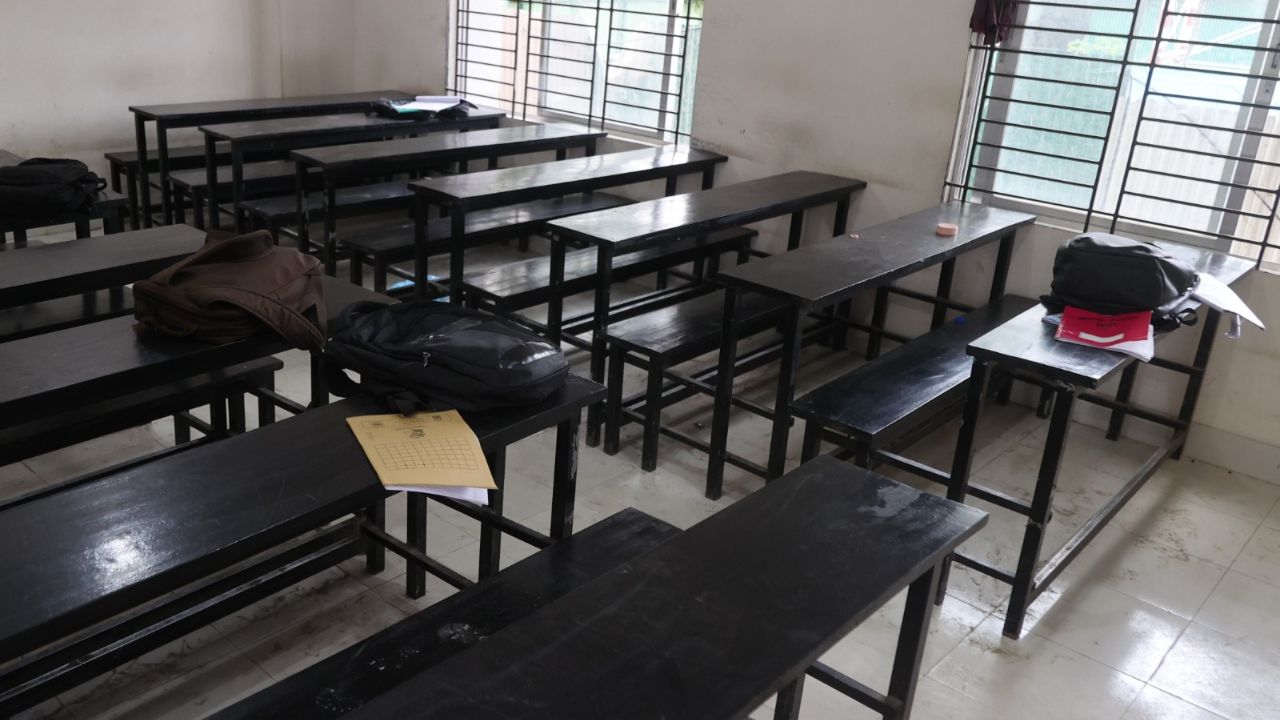
While the government is boosting classroom spending at its fastest rate in a decade, frustrated education stakeholders say the record numbers mask a grim reality.
They argue that years of chronic underfunding have left the system starved, directly fuelling a nationwide skills shortage that a simple one-year budget hike cannot fix.

For the upcoming 2026-27 fiscal year, Education Minister ANM Ehsanul Haque Milon has said that the education sector will get an allocation of Tk1,23,000 crore out of the nation’s total Tk9,38,000 crore outlay.

This marks a significant jump from the current fiscal year’s allocation of over Tk95,645 crore out of a Tk6,90,000 crore total budget.

Consequently, while the overall national budget size is growing by 18.73%, the education sector’s funding will increase by an even faster 28.79%, bumping education’s share of the total budget from just over 11% last year to 13%, and elevating its share of the GDP from 1.53% up to 2.00%.

Despite this rebound, the sector has a long way to go. In 2016-17, education spending sat at about 2.5% of GDP, but subsequent prioritization of mega-infrastructure projects caused education funding to lag behind and bottom out at a ten-year low in the current fiscal cycle.
Furthermore, a large portion of this new allocation is tied up in operational costs and physical infrastructure such as higher salaries, mid-day meals, school uniforms, bags, and multimedia classrooms.
Experts warn that without large-scale teacher training, the sector will not see meaningful qualitative benefits.
To fulfil the BNP government’s election promise of gradually raising education spending to 5% of GDP, the state must increase its current commitment two and a half times over. Ultimately, the new budget still falls short of Unesco’s international benchmarks, which recommend allocating at least 4% to 6% of GDP, or 15% to 20% of the total budget, to education.
“The education sector has always been neglected,” Mohammad Moninoor Roshid, a professor at Dhaka University’s Faculty of Education and Research, told TIMES of Bangladesh. “In Bangladesh, governments have not adopted any priority-based policies for educational development; they have prioritised their political activities instead.”
Professor Roshid emphasised that budget constraints plague the system from primary schools to higher education. “A radical change is needed here, for which the state must make a massive investment.”
Dr Manzoor Ahmed, Professor Emeritus at BRAC University, agreed on the need for funding but stressed the importance of fiscal responsibility. “It is vital to decide how we spend across different sectors,” Dr Ahmed noted. “Money must be utilised in a well-planned, transparent manner.”
Regarding sector-specific priorities, Dr Ahmed called for equity. “Budget allocation at the school level needs to be increased, as there is currently no safety net for disadvantaged students. To reduce educational inequality, schools should introduce extra-time remedial programmes as an alternative to private coaching. This would alleviate the heavy burden of private tuition fees on parents, and the government should directly fund this initiative.”
Comparative analysis of nat’l budget and education budget
Over the past decade, the education budget has generally fluctuated between 11% and 12% of the national budget, peaking only in the 2016–17 fiscal year at a decade-high of 14.38% (2.49% of GDP).
In the current fiscal year, approximately 70% of the education budget, roughly Tk 69,000 crore, is swallowed by recurrent expenditures like salaries, allowances, pensions, and gratuities for teachers and staff.
This fiscal strain is set to increase following the government’s decision to raise public sector basic salaries by 50%. This 50% basic salary hike will cost approximately Tk 2,000 crore alone for the 384,000 teachers across 65,000-plus government primary schools, with a similar additional expenditure incurred for over 500,000 teachers and staff across roughly 39,000 private, MPO-listed schools, colleges, madrasas, and technical institutions.
Meanwhile, the state secondary and higher secondary sectors employ over 15,000 teaching staff whose salary scales and allowances are significantly higher than those in primary education.
To address mounting backlogs and alleviate prolonged delays for educators waiting in line for post-retirement payouts, the upcoming budget earmarks Tk 2,000 crore specifically for retirement benefits and outstanding welfare trust payments for retired private MPO teachers.
Conversely, an analysis of budget documents reveals that less than 30% of the current allocation (about Tk26,000 crore) goes towards development initiatives like free textbook distribution, stipends, new building construction, and infrastructure renovations.
In terms of departmental distribution, the Secondary and Higher Education Division received the lion’s share of the current budget at Tk47,564 crore, followed by the Ministry of Primary and Mass Education at Tk35,403 crore, and the Technical and Madrasah Education Division at Tk12,678 crore.
This sector-wise pattern will broadly persist into the 2026–27 fiscal year: out of the proposed Tk123,000 crore education budget, the Secondary and Higher Education Division is projected to receive a maximum share of Tk50,302 crore, while Tk42,145 crore is set aside for the Ministry of Primary and Mass Education.
Historically, data shows the Technical and Madrasah Education Division consistently receives a fixed share of around 10% to 12% of the overall education budget; consequently, despite recent government rhetoric promising a revolutionary transformation of the technical education sector, this ambition is not reflected in the actual budget allocations.
What did BNP promise in election manifesto?
The BNP’s election manifesto pledged extensive educational reforms, most notably committing to gradually increase the education budget to 5% of the country’s GDP.
Following its landslide election victory, the administration began rolling out initiatives to introduce mid-day meals in government primary schools and provide free uniforms to pupils. State Minister for Primary and Mass Education, Bobby Hajjaj, announced that 17 lakh students will receive uniforms, shoes, and school bags in stages.
Furthermore, at least Tk550 crore will fund the ‘mid-day meal’ programme across all primary schools in three stages, with just over Tk200 crore earmarked for the upcoming financial year.
The manifesto also prioritises healthy school environments and upgraded sanitation. Consequently, primary school teachers are campaigning for at least one cleaning staff member per school and one night watchman for urban institutions.
Md Riaz Parvez, Headmaster of Gendaria Mohila Samiti Government Primary School in Dhaka, told TIMES: “It is vital to guarantee a healthy environment in primary schools. Many health-conscious parents are choosing not to enrol their children in government schools due to unclean bathrooms, classrooms, and poorly maintained school grounds.”
He added: “If the government intends to equip schools with multimedia classrooms, appointing security staff or night watchmen is essential. Without them, safeguarding this expensive equipment will be incredibly difficult.”
Beyond primary education, the manifesto outlines ambitious long-term goals, including free education up to postgraduate level for girls and undergraduate level for boys, resolving the chronic university accommodation crisis, boosting academic research, and upgrading the National University.
The plan also promises high-speed internet across all educational institutions, multimedia classrooms, and compulsory secondary-level technical education.
Executing the rest of the agenda requires substantial additional funding for remote learning environments, special needs education, tablets for all teachers, a mandatory third foreign language alongside Bengali and English, and “joyful learning” frameworks.
Concurrently, the Ministry of Primary and Mass Education is prioritising renovating dilapidated schools, developing playgrounds, furnishing pre-primary classrooms, and executing Primary Teacher Training Institute (PTI) infrastructure projects nationwide.
Assessing these plans, Md Shahnawaz Khan Chandan, member secretary of the research platform ‘Shiksha Odhikar Sangsad’ and Jagannath University assistant professor, told TIMES: “A massive budget is required for the holistic development of the education sector.
“Even with the recent increases, the current budget will fall short of fulfilling all the material pledges outlined in the government’s manifesto. Moving forward, it is critical that the government shifts its focus towards structural improvements: teacher training, upgrading training infrastructure and management, enhancing educator skills, and raising overall classroom standards.”
