

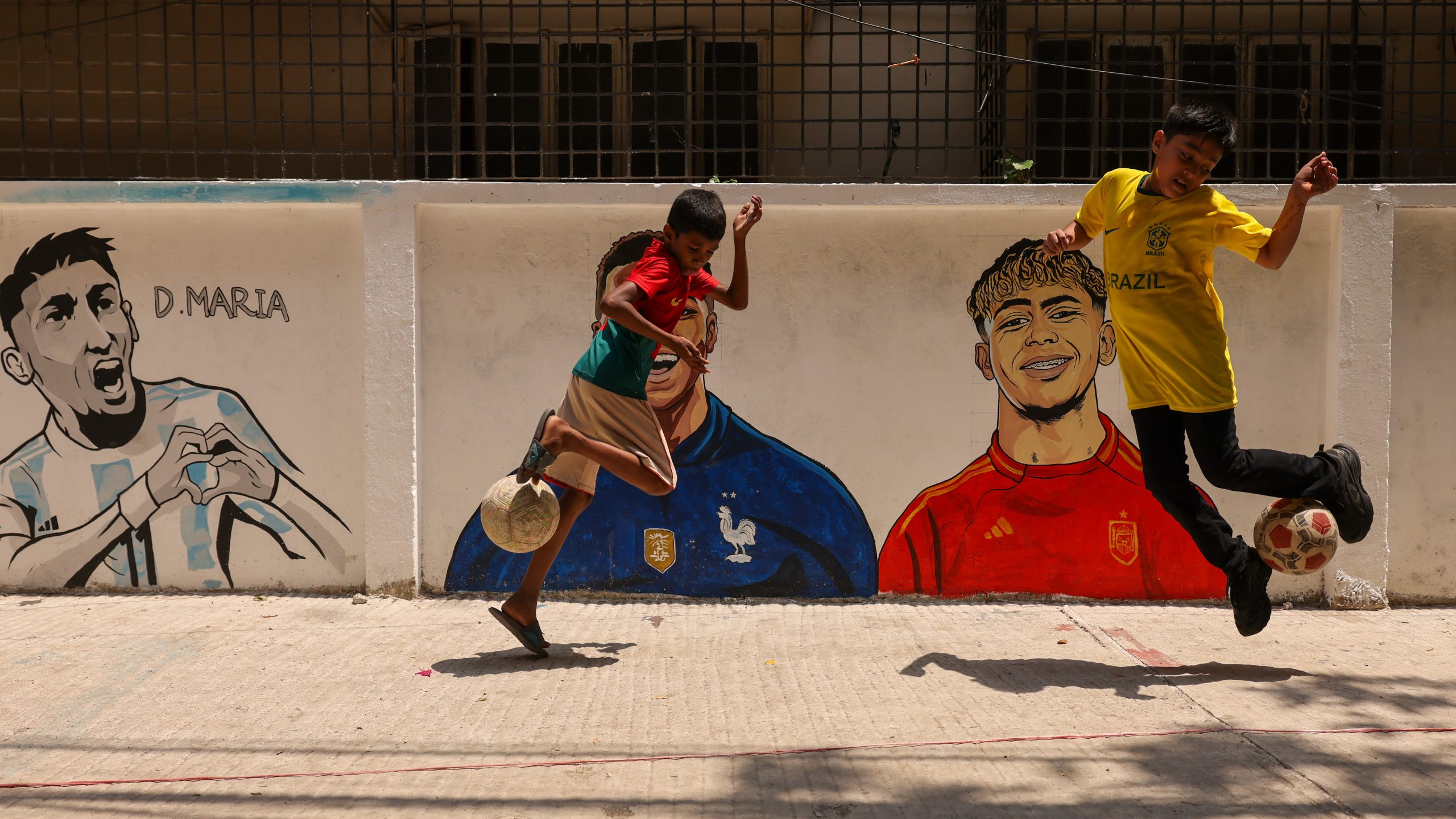
The subcontinent does not have a team in this World Cup. It has never had one. Yet across Bangladesh, India and Pakistan, nearly two billion people are preparing to lose sleep over a tournament being played in North America between nations most of them have no ethnic or political connection to. That paradox, repeated every four years, is one of football’s most remarkable stories, and it is playing out again right now.
In Bangladesh, the relationship with the World Cup is unlike anything else in world sport. It began in 1986, when the country’s sole television channel broadcast the Mexico tournament in colour for the first time. Diego Maradona won it for Argentina that summer, and the image burned itself into a generation. Argentina’s 1986 triumph was the first World Cup to be screened in colour in Bangladesh, and Maradona’s performance captivated a country that had never seen anything like it. What followed was not fandom but devotion, passed down through families like an inheritance.

Argentina and Brazil flags dominate towns across the country for weeks before each tournament, with supporters holding processions and motorcycle rallies, and rival factions holding meetings to plan further displays of loyalty. At previous World Cups, the fervour turned fatal. At least seven people have died trying to display national flags over their homes, after being electrocuted or falling from rooftops, and at least three more died after rival fans clashed in rural towns.

In 2022, that passion finally received global recognition. As Argentina progressed through the Qatar tournament, hundreds of thousands of fans gathered in Dhaka and other cities in chilly temperatures, waving flags and wearing Messi’s number 10 shirt to watch matches on giant screens. FIFA shared clips of the celebrations. Gary Lineker expressed disbelief. Argentine fans in Qatar were filmed asking for prayers from Bangladesh, chanting “Bangladesh-er doa chai”, and Argentine media opened a Facebook group for Bangladesh’s cricket fans in return. A country almost 17,000 kilometres from Buenos Aires had become, for those weeks, the most visible Argentina supporter base on earth.
This year, though, something feels different. Walk through Dhaka and the flags are there, but fewer of them. The bunting is sparser. The motorcycle processions have not started with their usual ferocity. Part of the reason is practical: the World Cup begins at inconvenient hours given the North America time zone, and the initial broadcasting fiasco threatened to leave the country without coverage entirely. A Singapore-based company acquired the rights for Bangladesh and then failed to sell them on, leaving the nation without a broadcaster less than a fortnight before the opening match. The government eventually stepped in, negotiating directly with FIFA and spending Tk 72 crore 70 lakh to secure all 104 matches for BTV, Somoy TV and T Sports. In India, Zee Entertainment resolved weeks of uncertainty by paying FIFA a reported $40 million for the 2026 and 2030 rights, far below FIFA’s original asking price, and only after broadcasters across Asia had balked at the cost.

The muted atmosphere has not gone unnoticed. Baten Chakma, who runs the popular Facebook page Football Talk With Baten, told TIMES of Bangladesh: “The hype around this World Cup seems a little lower in Bangladesh. It is not completely absent; there is a moderate level of excitement. But the scenes we usually see, like flags going up on every building and house two or three days before the World Cup, flags being hung along every street, that is a little less visible this time.”
He pointed to two reasons. “One is the economic situation. At the moment, after Covid and after the political changes, almost everyone in Bangladesh is in a difficult financial position. As a result, the spending that comes with putting up flags or doing something extra for your favourite team is something many people either cannot afford right now, or are choosing to save instead.” The other, he said, was the quiet growth of domestic football. “After Hamza’s arrival the hype around Bangladeshi football has meant people are still following and supporting, but in my view it is just not being expressed or displayed outwardly in the same way.”
Md Kawser Bin Mostafiz, who runs the Facebook page Nischup Sowvik with 605,000 followers, offered a similar diagnosis. “People treat football as entertainment, and entertainment feels good when your life is running smoothly,” he told TIMES of Bangladesh. “When prices are rising, when you have to struggle constantly just to survive, when life has become mechanical, the space for entertainment in your life shrinks considerably. People may be excited about the World Cup in their minds, but they cannot express it.”
Beyond economics, Kawser identified a crisis of anticipation at the heart of the tournament itself. Argentina’s 2022 triumph had quietly deflated their own fanbase in Bangladesh. “The hunger that Messi had for 36 years, or the hunger Argentina’s fans had for 36 years, that has been satisfied,” he said. “Argentine fans are watching this World Cup in a fairly relaxed state. You are not getting a great deal of hype from Argentine fans.” Brazil’s situation was no better. “I do not see Brazil fans speaking confidently about winning the World Cup the way they once did.”
He reserved his sharpest criticism for the organisers. “The biggest reason I would give is that FIFA or America has not generated the kind of frenzy around the World Cup that is needed, the kind we saw at the South Africa World Cup or the Qatar World Cup. The timing is very odd, and from the theme song to any premium promotional video, none of it has managed to create hype.”
Azim Nowaz, who runs the Facebook page Talking Tiki Taka with 147,000 followers, was equally blunt when he spoke to TIMES of Bangladesh. “I don’t have a short answer, only a long one. But in summary, we lack the hunger, discipline and honesty needed to succeed on the world stage,” he said. On the tournament itself, he was direct: “Because of the schedule and the poor PR surrounding the USA, if someone asks you when a match is, you probably won’t be able to answer. There’s no clear structure or build-up to anything. The group stage is full of dead rubbers. There’s no real group of death. There’s no risk either. With third-placed teams qualifying, all the major nations will get through. You could easily argue there won’t be a genuinely big match until the quarter-finals.”
Kawser, though, was not entirely without hope. “There was a time when we were watching the absolute peak of World Cup hype. Right now we are in a down period. But there will come a time when we see this hype rise again, and we will see that very soon, when Lamine Yamal and Alvarez are in their primes.”
Both men also turned to the longer question of whether Bangladesh could one day have a team of its own to follow. Baten framed it as a matter of ambition and study. “In South Asia, all we can do is enjoy the World Cup or watch it and be happy. But rather than simply being happy, we can learn a great deal. Japan’s project, Morocco’s project, those are the reason those nations are participating in the World Cup today. We too can learn from such projects and take one up ourselves, setting a target right now for the 2034, 2038, or later World Cups and beginning preparations from today.”
Kawser agreed, but pointed to a deeper structural problem. “We have to identify and bring out our talents from school level. We have to improve our infrastructure, upgrade our pitches, develop our academies, and give players the assurance that if they choose football as a career, their future will not be plunged into darkness,” he said. “But in our country, if someone chooses football and ultimately their career does not take off, if they cannot become a successful footballer, they have no value in our society. When we come out of that situation, talented footballers will gradually emerge.”
There is a broader truth here. The subcontinent’s World Cup love has always been borrowed, which makes it both extraordinary and fragile. Bangladesh has no team to qualify, no moment of national reckoning on the pitch. What it has instead is the accumulated weight of memory, community and identity built around other nations’ stories. That is enough to produce some of the most remarkable scenes in the history of the sport. The streets of Dhaka will have their answer when the first whistle blows on 12 June.
