

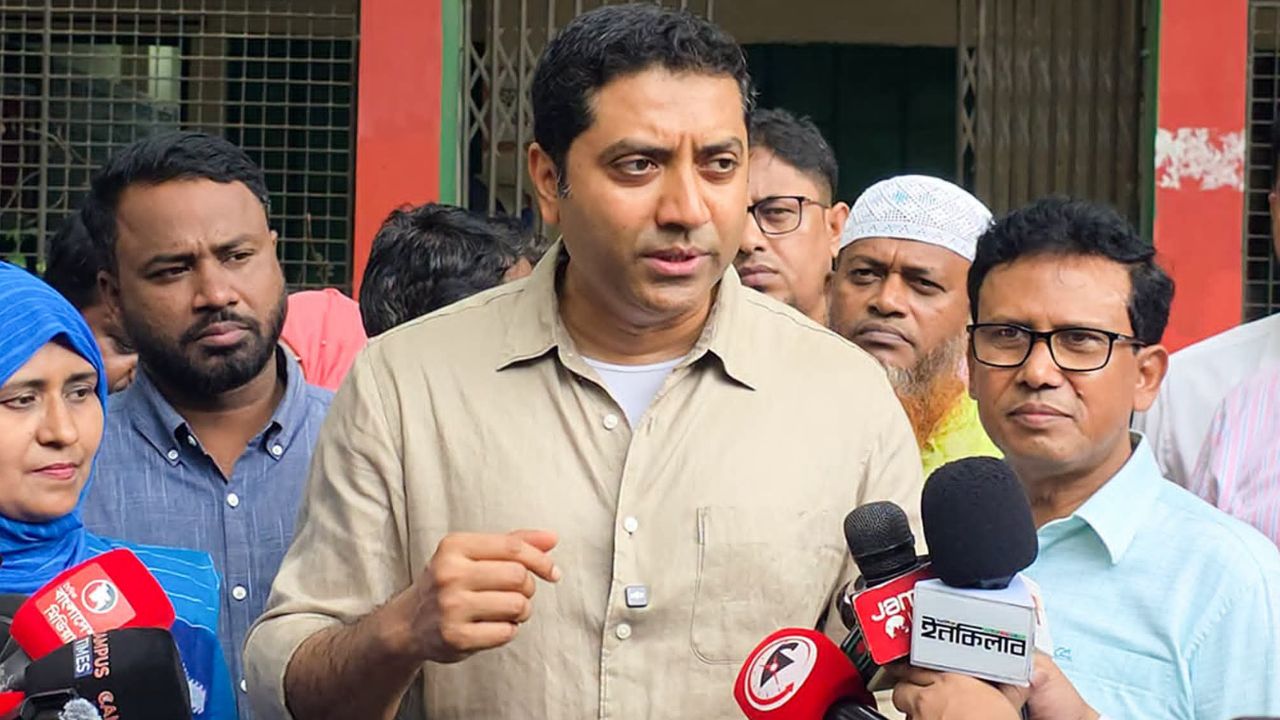
State Minister for Primary and Mass Education Bobby Hajjaj has said the government is implementing an integrated and long-term action plan to attract students to schools, eliminate learning gaps, and establish a world-class primary education system.
To achieve this, the government is simultaneously working on the distribution of free uniforms, the establishment of technology-based classrooms, a newly re-aligned curriculum, a teacher development policy, and the improvement of school infrastructure.

The state minister made these remarks during a discussion with media personnel at Agargaon Taltola Government Primary School on Monday, following his inspection of various government primary schools in the Dhaka North City Corporation (DNCC) area.

The state minister noted that he has been personally visiting government primary schools across different regions of the country for the past four months.
Currently, a special initiative has been undertaken to observe the infrastructure development, classroom environment, and the actual state of educational activities in Dhaka’s government primary schools.
Under the ongoing “Drishtinandan” (Aesthetic) project, authorities are conducting field-level evaluations to identify existing gaps and modernise the capital’s primary schools.
Sharing his experience of interacting with students during these visits, the state minister mentioned that he did not conduct formal classes but instead monitored their learning progress through storytelling and various educational activities.
He observed that while most students are performing well, some are lagging in specific subjects. Consequently, he has instructed the teachers concerned to pay special attention to these students.
Bobby Hajjaj further revealed that the current curriculum is being re-aligned to be simpler, more effective, and student centric.
Simultaneously, work is progressing on a comprehensive teacher policy that integrates recruitment, training, Continuous Professional Development (CPD), Key Performance Indicators (KPI), responsibilities, supervision, and training structures at the Upazila and District levels. Significant progress was made on this matter during a recent high-level meeting.
As part of a technology-driven education system, the government plans to introduce video lessons, smart classrooms, flat panels, and an instantaneous evaluation system, alongside modern methods to identify and address student learning gaps.
“Our goal is not just infrastructural development; we want to bring a fundamental change to the quality of education,” Bobby Hajjaj said. He emphasised that the government is working to elevate primary education to international standards by coordinating students, teachers, administration, technology, and the curriculum.
He expressed optimism that, under the leadership of Prime Minister Tarique Rahman, the government is determined to bring about a revolutionary change in primary education, ensuring a modern, high-quality, and joyful learning environment for every child in the country.
The visit was attended by Divisional Deputy Director of Primary Education (Dhaka Region) Md Abdul Aziz, the district primary education officer, various thana primary education officers, as well as students and parents.
