

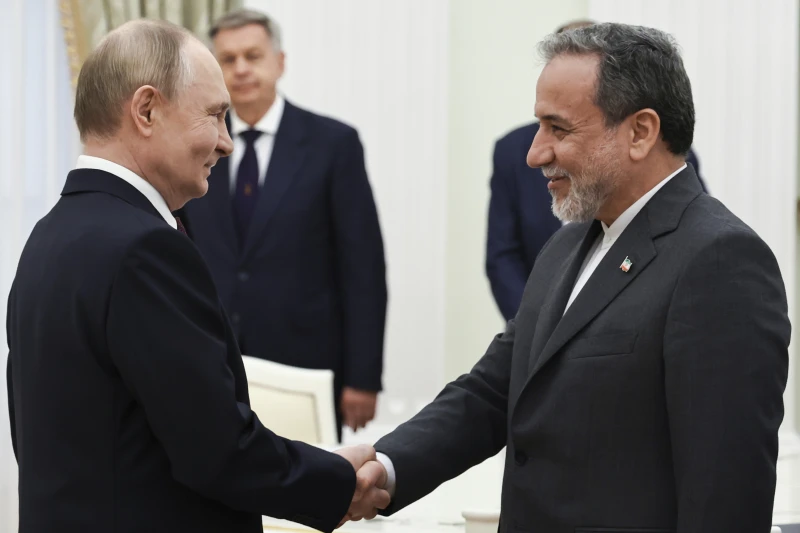

Iran’s Foreign Minister Abbas Araghchi has arrived in Moscow for high-level talks, including a meeting with President Vladimir Putin, as diplomatic efforts to end the conflict with the United States remain stalled.
Araghchi blamed what he described as “excessive demands” from Washington for the collapse of recent negotiations. During his meeting, Putin expressed hope that the Iranian people would overcome what he called a “difficult period” and reaffirmed Russia’s willingness to support Iran and regional stability, according to state media.

Meanwhile, US President Donald Trump signalled openness to renewed dialogue, saying Iranian leaders “can come to us, or they can call us” if they wish to resume talks. His remarks came a day after he cancelled a planned visit by US envoys to Pakistan for negotiations.

In a parallel development, Iranian officials indicated that, under a proposed law, the country’s army would assume responsibility for managing the Strait of Hormuz, underscoring Tehran’s intent to consolidate control over the strategic waterway. At the same time, US Central Command (CENTCOM) said American forces remain “focused and ready” across the Middle East as the diplomatic impasse continues.
Mediators still seek to bridge US–Iran gaps
Despite the breakdown of face-to-face diplomacy, mediators—particularly Pakistan—continue efforts to narrow differences between Washington and Tehran. Iranian sources revealed a new proposal that would defer discussions on the nuclear programme until after a ceasefire is firmly established and disputes over Gulf shipping are resolved.
However, this approach is unlikely to satisfy the United States, which insists that Iran’s nuclear ambitions must be addressed at the outset of any agreement.
Araghchi has been actively engaged in shuttle diplomacy, travelling between Islamabad, Muscat, and now Moscow in recent days. His visit to Russia highlights Tehran’s reliance on longstanding allies as negotiations with Washington remain uncertain.
With both sides far apart on key issues—including nuclear restrictions and access through the Strait of Hormuz—global markets have begun to react. Oil prices rose again on Monday, with Brent crude climbing about 2.5 per cent to around $108 per barrel.
Trump reiterated Washington’s position in an interview, saying: “They know what has to be in the agreement. It’s very simple—they cannot have a nuclear weapon.” The White House declined to comment on specific proposals, emphasising that negotiations would not be conducted publicly.
Trump faces domestic pressure
As the conflict drags on, Trump is facing growing domestic pressure to bring the war to an end amid declining approval ratings. While Iran has suffered military setbacks, it retains significant leverage through its ability to disrupt shipping in the Strait of Hormuz—a route that normally carries about one-fifth of global oil supplies.
Iranian officials have outlined a phased negotiation framework. The first step would involve ending the war and securing guarantees against renewed hostilities. Subsequent stages would address the US maritime blockade and the reopening of the strait under Iranian oversight.
Only after these issues are resolved would talks move to the long-standing dispute over Iran’s nuclear programme. Tehran continues to seek recognition of its right to enrich uranium for what it maintains are peaceful purposes.
Europe warns of strategic risks
European leaders are increasingly concerned about the trajectory of the conflict. German Chancellor Friedrich Merz warned that the United States risks strategic failure, arguing that Washington lacks a clear exit strategy.
Drawing comparisons with past conflicts in Afghanistan and Iraq, Merz said Iran appears to be negotiating from a position of strength. He cautioned that the prolonged crisis is already having economic repercussions, including rising energy costs and pressure on global markets.
“The situation is deeply complex and costly,” he said, urging a swift resolution to prevent further economic fallout.
