

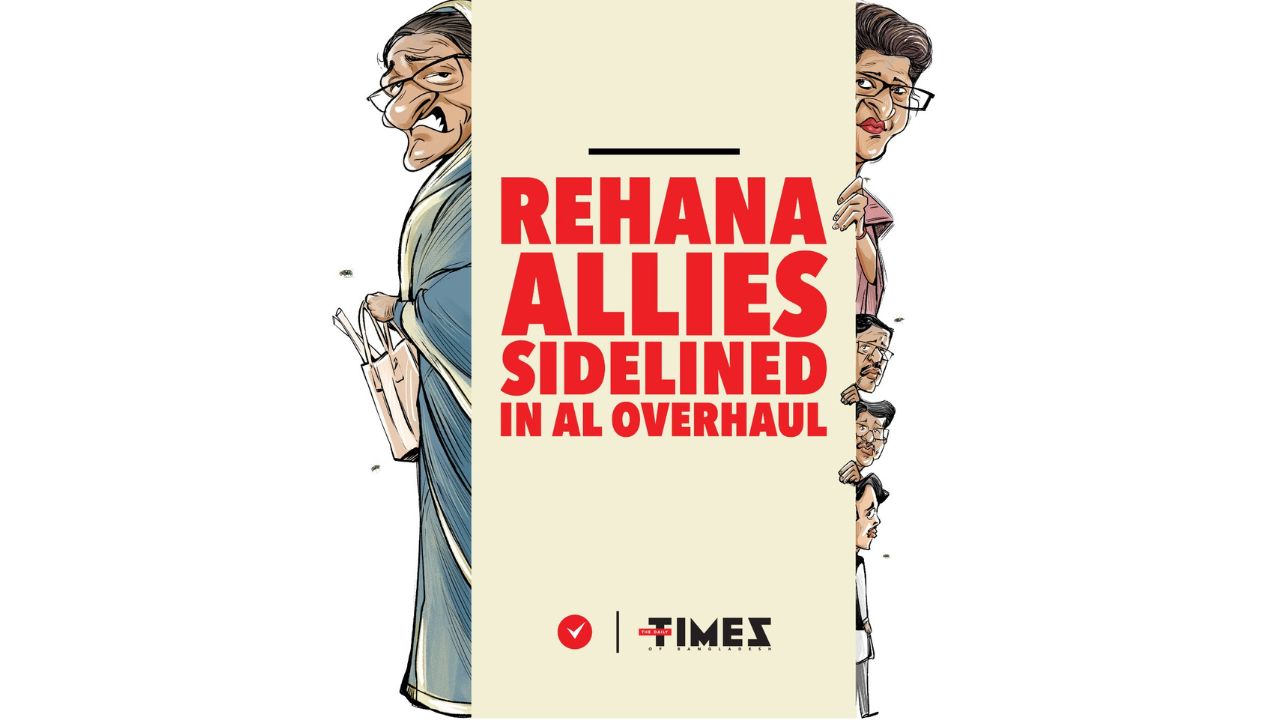
Ousted prime minister Sheikh Hasina is distancing herself from a powerful political network long associated with her younger sister Sheikh Rehana, according to multiple Awami League insiders, in what appears to be an attempt to rebuild the party after its dramatic fall from power in August 2024.
Senior party figures described the move as part of a broader internal reassessment within the Awami League, where allegations of misuse of state power, corruption, political patronage and public anger are increasingly being blamed for the party’s debacle.

Several leaders perceived to be close to Rehana are now under pressure, party sources said, adding many of them could be pushed out of frontline politics as the party undergoes restructuring while its leaders are either in exile or in prison.

Although relations between the two sisters remain personally cordial, AL sources told TIMES of Bangladesh that Hasina no longer places the same importance on Rehana’s opinion regarding party management and political affairs.

The shift comes after years of speculation surrounding an influential power circle linked to Rehana and her brother-in-law Tarique Ahmed Siddique, a former army general and security adviser to Hasina in power. The network was widely discussed within political and bureaucratic circles during successive Awami League governments formed after the elections of between 2009 to 2024.

According to party insiders, the group played a major role in appointments across government ministries, advisory positions, the civil administration, the military and intelligence agencies.
While the allegations were never publicly acknowledged by senior leaders, critics within the party had long privately complained about the group’s concentrated influence and opaque decision-making in the government.
Several sources linked to AL alleged that business figures and politically connected elites also gathered around the Rehana-linked circle, which they said became highly influential during the party’s rule for 15 years and a half.
The same sources claimed that allegations of financial transactions linked to appointments and postings circulated widely within party ranks, although no visible disciplinary action was taken at the time.
Party sources said the former prime minister has been discussing the successes and failures of her government, public dissatisfaction, and the causes behind the party’s downfall with trusted associates and former officials now living abroad.
An Awami League leader based in Europe told TIMES that Hasina wants to reorganise the party with a stronger focus on leaders seen as publicly acceptable and less controversial.
“She wants to move away from figures associated with corruption, controversy and public anger,” the leader said.
Leaders affiliated with the party’s UK and US chapters said Rehana’s influence over government and party affairs had long been a subject of internal discussion.
They pointed to controversies surrounding businessman Salman F Rahman, the influence of industrial conglomerate S Alam Group, appointments of senior military officials, and Tarique Siddique’s reported role within the military establishment.
According to those leaders, Hasina now wants to limit Rehana’s future role in organisational decisions in order to avoid repeating the same political mistakes in future.
Two AL leaders currently based in Kolkata said Hasina is now personally focused on rebuilding the party structure and maintaining direct communication with district, upazila and union level organisers.
Talking to TIMES, party’s Joint Secretary AFM Bahauddin Nasim said Sheikh Hasina continues to oversee party activities herself from New Delhi, the Indian capital she has been staying since she fled Bangladesh amid a mass uprising.
“She is directly monitoring organisational activities and staying connected with party leaders and activists,” he said.
Nasim said the party chief spends large parts of the day and night communicating with grassroots activists through WhatsApp, Telegram and phone calls, offering instructions and encouragement.
He claimed that the strategy was helping reactivate many previously inactive party members working under difficult political conditions.
However, party insiders said Hasina is increasingly unwilling to trust leaders accused of corruption, irregularities or political controversy. The names of several presidium members, joint general secretaries, organising secretaries and former members of parliament are reportedly being discussed internally, although no formal disciplinary process has been announced.
Nasim rejected those claims, describing them as “planned propaganda by the deep state”.
AL insiders said figures seen as actively engaged in rebuilding organisational networks appear to be gaining Hasina’s confidence.
Among the names frequently mentioned by party insiders are Presidium Members Mofazzal Hossain Chowdhury Maya, Jahangir Kabir Nanak and Sheikh Fazlul Karim Selim; former home minister Asaduzzaman Khan Kamal, Joint General Secretary AFM Bahauddin Nasim, Organising Secretary Mahibul Hasan Chowdhury Nowfel and former state minister Mohammad A Arafat.
According to party sources, Nanak, Maya and Sheikh Selim have chaired several virtual party meetings attended by Hasina, a development many inside the party interpret as a signal about the party’s future leadership structure.
Nowfel and Arafat are also said to be playing increasingly visible roles in international outreach and diplomatic engagement efforts.
Hasina has also come to recognise the political value of leaders with comparatively cleaner public images and stronger international acceptability, claimed the sources. Former Speaker Shirin Sharmin Chaudhury, former minister Saber Hossain Chowdhury and former Narayanganj mayor Selina Hayat Ivy are among the names being discussed in that context.
The party is also planning to introduce younger leadership in Dhaka, Chattogram, Gazipur and Narayanganj as part of efforts to strengthen the organisation ahead of future political mobilisation.
The former prime minister considers those four metropolitan areas strategically important for rebuilding the party and preparing for future anti-government political campaigns and organisational battles, according to party sources.
