

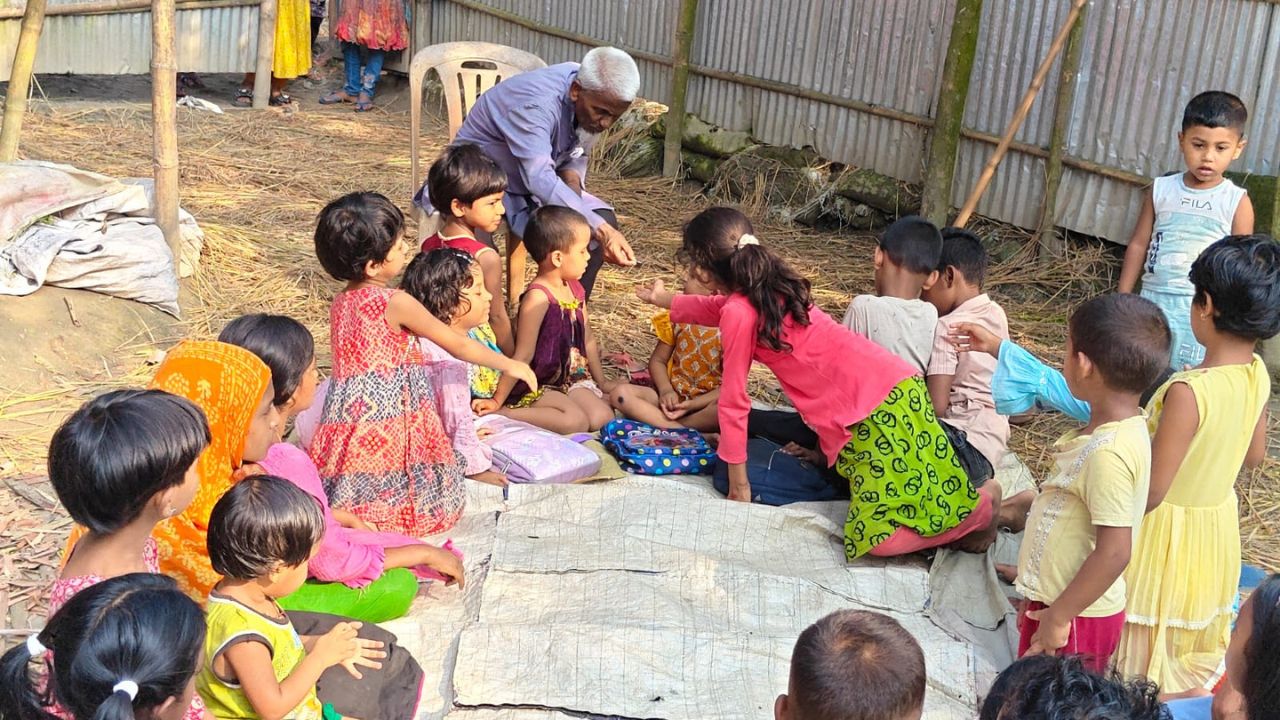
It is mid-May in Modnepara village under Kanchipara Union. The afternoon heat still hangs in the air. The school bell has already fallen silent half an hour ago.
Yet from a quiet courtyard, a voice still rises clearly: “Aye chelera, aye meyera.”

Inside the yard, 20 to 25 children sit in a circle, focused and still. Parents stand nearby, watching quietly. For nearly one and a half hours, the lesson continues under the man they all call the “One Taka Master”. After class, each student places one taka in his hand.

That teacher is 78-year-old Lutfar Rahman.

He lives on a river embankment near Baguria village under Gidari Union in Gaibandha Sadar upazila. His home stands beside the Brahmaputra river. From this riverbank life, he has built something far larger than a classroom—he has built a legacy.

For around 52 years, he has walked from village to village, teaching children from poor families. His fee has remained unchanged: just one taka a day.

Years have passed as the Brahmaputra and Teesta have carried away water. Prices have climbed. Currency has lost its value. But Lutfar Rahman has never increased his fee. He never turned one taka into two. That is why people know him as the One Taka Master (Ek Takar Master).
Lutfar Rahman was born in 1948 into a wealthy family in Urya village under Fulchhari Upazila. His father was Foymuddin Bepari.
After passing SSC in 1972 from Goonvari B L High School, life took a harsh turn. In 1974, river erosion by the Brahmaputra destroyed his family’s wealth and left his father ruined. Financial hardship forced Lutfar to stop his studies.
From that moment, he began teaching underprivileged children along the riverbank. He never stopped again.
After losing everything to erosion, he took shelter on the WAPDA embankment in Gidari Union of Gaibandha Sadar upazila.
Locals now describe him as a “pure-hearted man”. Several organisations in the area have also honoured him with awards.
Parents speak of him with deep respect.

Morzina Bewa said, “My children studied under the One-Taka Master. Now my grandchildren study there too.” She added, “Even though the Master has helped many children in our village progress, his own life has not improved.”
Namza Bewa shared a similar story. “All my six daughters studied under him,” she said. “We once faced extreme hardship. Now one of my daughters is a teacher and another works at a private bank. Not only mine, many children in the area have become successful through his teaching.”
Former student Ashraful Islam said, “I am 40 years old. People 15–16 years older than me also studied under him.” He added, “Many of his students are now established, but the Master has achieved nothing in life.”
Another student, Sourav Mia, said, “He does not want money. His main goal is to keep rural children on the path of education.”
His elder son, Lablu Mia, described a life shaped by sacrifice. “He never beats children. He teaches with love, care and affection,” he said.
“Many days we even went without food. Now my two brothers earn well. We tell our father not to go door to door teaching, but he does not listen. Teaching is his passion,” Lablu added.

Lutfar Rahman himself still remembers the early days. “At that time, I taught 10 students and earned 10 taka. That money could buy many things in the market,” he said.
Over time, he found something deeper than income in teaching. He never considered another profession.
He said, “Most people in this area are poor. I do not teach for money. I teach so children can become educated, become assets of the country, and bring smiles to their parents’ faces.”
Today, among thousands of his students, many have become university teachers, doctors, engineers, bankers, lawyers and professionals in different fields.
But age remains his only barrier. His mind still feels young. Every day, he pushes past that limit. From morning to evening, he cycles miles after miles, moving from house to house to teach.

The region around him is still shaped by hardship. Most families are poor farmers. He knows parents cannot afford good teachers, coaching or schools. For them, he remains the only hope.
Gidari Union Parishad Chairman Md Harun-or-Rashid Edu said, “Everyone in Gaibandha knows about Lutfar Master. He has suffered greatly while serving society and the country. Such a noble person is very rare.”
College teacher Harun-or-Rashid added, “He is a selfless and generous man. His sacrifice, affection and dedication continue to shine as a beacon of inspiration for rural education.”
As the sun sets over the Brahmaputra, the river keeps flowing. So does his work. One lesson. One child. One taka at a time.
