

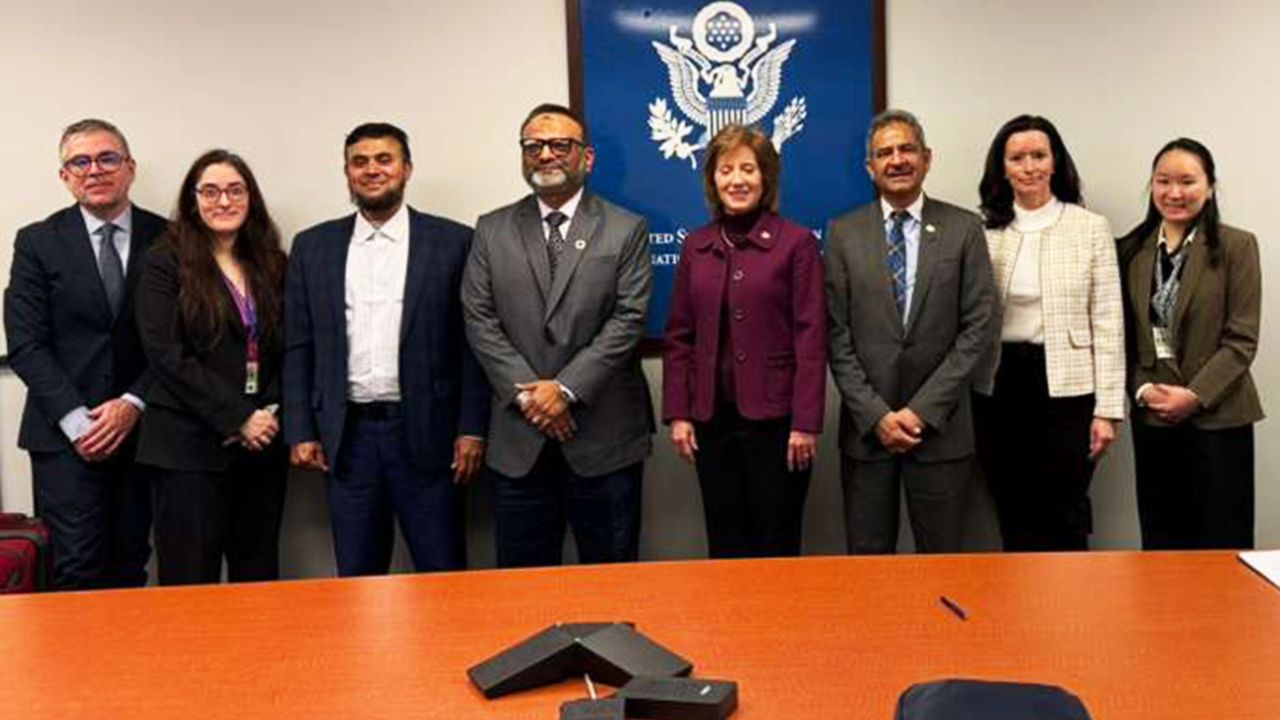

Dhaka University Vice-Chancellor Professor Niaz Ahmed Khan highlighted Bangladesh’s perspective on religious freedom, communal harmony, coexistence and ethical leadership at two international forums in Washington, DC, during a recent visit to the United States.
Last Wednesday, Professor Khan attended a meeting at the office of the United States Commission on International Religious Freedom (USCIRF), where he met with the commission’s chair, Vicky Hartzler, along with other senior officials.
During the same visit, he also participated as a special speaker at the Global Faith Forum. He has since returned to Bangladesh, according to a press release.
At the USCIRF meeting, in-depth discussions were held on Bangladesh’s recent social and political developments, the election-time context and issues related to communal tensions. The meeting was coordinated by the Multi-Faith Neighbors Network (MFNN).
Professor Khan presented Bangladesh’s long-standing historical tradition of coexistence, noting that communal harmony at the grassroots level remains strong.
He said that most incidents of violence involving minority communities are politically motivated. Of the approximately 574 incidents recorded, only 71 had a direct religious dimension, while the rest were linked to land disputes, local conflicts or opportunistic political activities.
He also referred to developments following the July 2024 movement, stating that restoring academic activities at the University of Dhaka and preserving interfaith unity were treated as priorities.
Since assuming office, the university has undertaken year-long initiatives to promote interfaith harmony, including large-scale celebrations of Durga Puja, inclusive Eid programmes and major Christmas events.
Regarding the current situation, he said stability prevails at the University of Dhaka. While some isolated incidents have occurred at the national level, there is no evidence of systematic targeting of minority communities.
He noted that although elections are a sensitive period, efforts are underway to strengthen security.
Touching on regional geopolitics, Professor Khan referred to tensions in India-Bangladesh relations and attempts by Pakistan to exploit the situation.
However, he expressed the view that the likelihood of large-scale communal violence after the elections remains low and reaffirmed the commitment to ensuring the safety of the Hindu community.
He proposed the formation of a central academic monitoring cell to observe and analyse communal incidents and recommended the academic institutionalisation of the principles of the Marrakesh Declaration.
At the Global Faith Forum, Professor Khan described the platform as an example of global dialogue grounded in intellect, research and hope. Reflecting on Bangladesh’s history, he said the country has, for centuries, nurtured a culture of coexistence and tolerance among people of different faiths.
He noted that Islam spread peacefully in the region through the Sufi tradition and that incidents of communal violence, though present, have largely been driven by political motivations.
Highlighting the historic role of the University of Dhaka, he said that every major national transformation—including the 1952 Language Movement, the 1971 Liberation War and the July 2024 student movement—had the university at its centre.
