

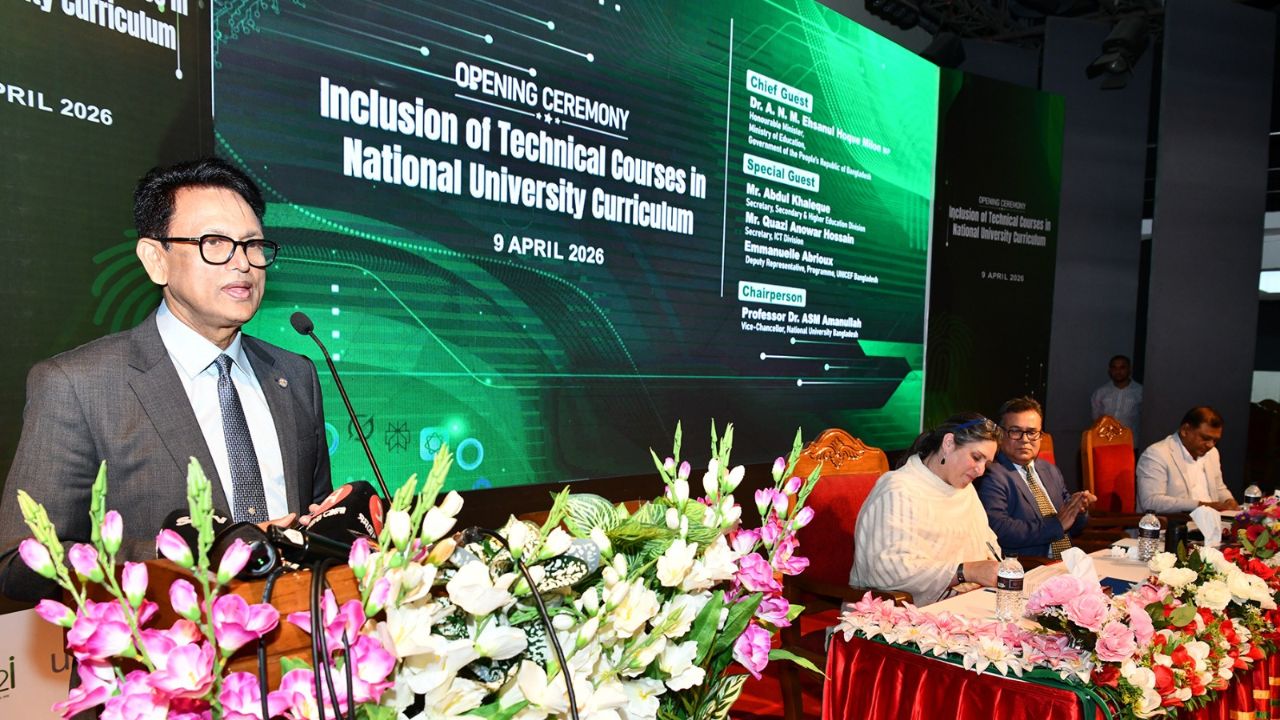

National University (NU) is moving to embed technical and skills-based courses into its curriculum to tackle graduate unemployment and better align education with labour market demands, as the institution seeks to modernise teaching for more than 4 million students.
The university, which oversees 2,284 affiliated colleges and accounts for around 70 per cent of Bangladesh’s higher education enrolment, said many of its students—largely from middle- and lower-middle-income families—remain jobless due to outdated academic programmes and limited technical and English proficiency.


To address the gap, the university has launched a curriculum overhaul under Outcome-Based Education guidelines, integrating technical training and employability-focused learning into undergraduate programmes.
Under the plan, an Advanced ICT course will be introduced in the second year, followed by specialised, skills-oriented courses in the third and fourth years, including Artificial Intelligence, Social Business, Digital Entrepreneurship, Data Analytics and Computer Programming. Awareness-based subjects such as Cyber Security and Digital Wellbeing are also being added to prepare students for emerging challenges.
Soft skills training—covering Communication, Cognitive Empowerment, Time Management, Productivity, Presentation, Leadership and Financial Literacy—is being prioritised to strengthen overall competency and improve competitiveness in domestic and international labour markets.
The initiative is being supported by the ICT Division’s a2i programme and UNICEF Bangladesh.
The reform process was formally launched at a three-day workshop inaugurated on Thursday at the International Mother Language Institute in Segunbagicha, Dhaka, with Education Minister ANM Ehsanul Haque Milon attending as chief guest.
He said the National University, established in 1992 by former Prime Minister Begum Khaleda Zia to address structural challenges in higher education, had yet to fully realise its founding goals. The current administration’s curriculum reform, he said, represents a landmark shift towards employment-oriented education.
The minister expressed hope that the workshop—bringing together public university teachers, college principals, students and industry representatives—would deliver a demand-driven curriculum that boosts employability and fosters innovation.
Chairing the event, National University Vice-Chancellor ASM Amanullah said Bangladesh continues to lag behind peer countries due to insufficient investment in education, underscoring the need for urgent reform.
He said the university has signed around 30 memoranda of understanding with domestic and international institutions over the past nearly two years to enhance education and research quality.
Compulsory courses in English, Bangladesh Studies, Culture and Identity, and ICT have already been introduced at the undergraduate level, while plans are under way to introduce a third language and establish a world-class forensic laboratory to support advanced learning and research.
Amanullah said the reforms, backed by the government, aim to introduce globally recognised modern education systems capable of producing skilled, employable and future-ready graduates who can strengthen Bangladesh’s global standing.
Among those present at the opening were Secondary and Higher Education Division Secretary Abdul Khaleque, ICT Division Additional Secretary and a2i Project Director Md Abdur Rafiq, and UNICEF Bangladesh Deputy Representative Emmanuel Abrioux.
National University Pro Vice-Chancellor Md Lutfor Rahman delivered the vote of thanks, while Treasurer ATM Jafarul Azam, Registrar Molla Mahfuz Al-Hossain, faculty deans, the Controller of Examinations, department heads and senior officials also attended.
The programme began with a one-minute silence in memory of the martyrs of the Liberation War and the July mass uprising, followed by screenings of documentaries on the National University and its founder Begum Khaleda Zia.
