

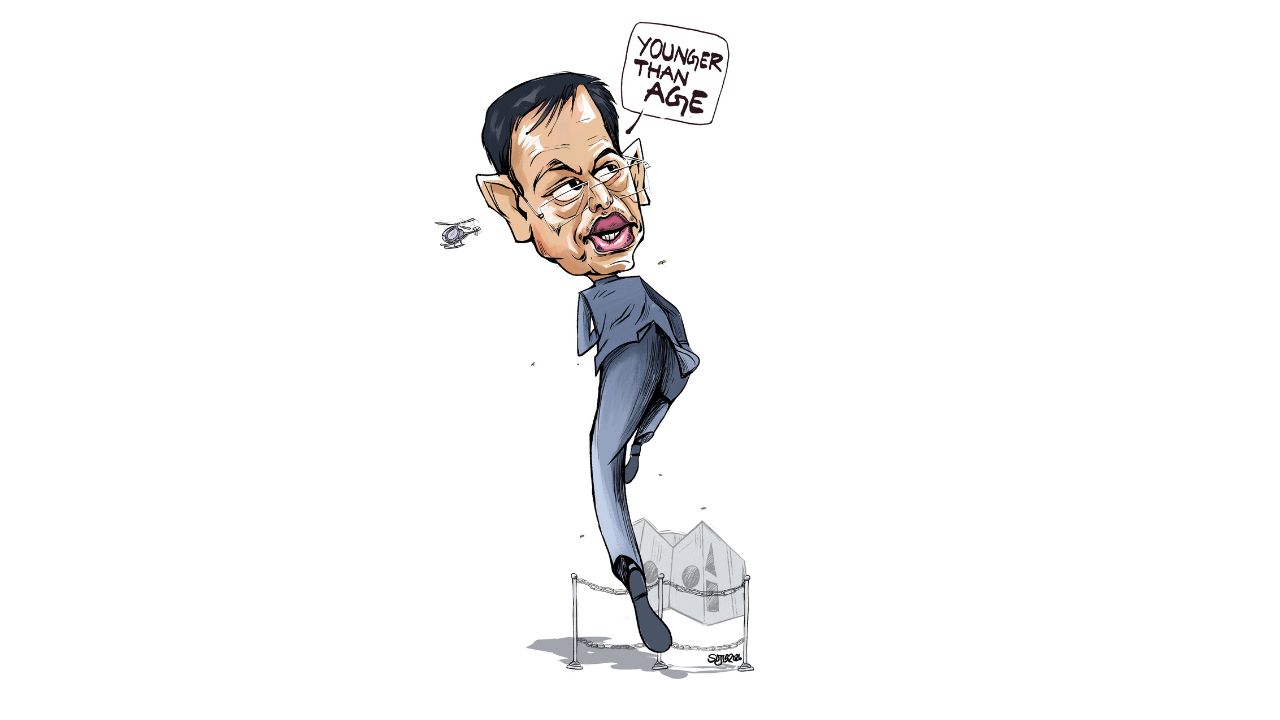

Education Minister ANM Ehsanul Hoque Milon has drawn criticism for repeatedly highlighting exam cheating, with teachers and academics arguing that the emphasis risks diverting attention from deeper and more pressing problems across the country’s education system.
In one of numerous short videos circulating on social media, the 69-year-old is seen addressing a group of young children, asking whether they are studying properly and urging them to avoid cheating.


The children appear very young, prompting questions over whether they even understand what cheating means.
Milon, who returned to ministerial office after two decades, has consistently raised the issue of cheating in public speeches, presenting it as a major concern within the education sector. However, his remarks have triggered a negative reaction among teachers, educationists, students, parents and the wider public.
Critics argue that either the minister is failing to prioritise the most urgent challenges facing the sector or is deliberately sidestepping them.
Emeritus Professor Manzoor Ahmed of Brac University told TIMES of Bangladesh that while everyone wants examinations to be conducted properly, an excessive focus on them could be counterproductive.
“Exams are not everything,” he said. “If the government concentrates solely on examinations, that creates problems.”
He added that repeated emphasis on cheating in Secondary School Certificate (SSC) and Higher Secondary Certificate (HSC) exams risks diverting attention from core issues such as education quality, school management and teacher training.
A legacy issue revisited
Cheating was once a major challenge in the country’s public examinations. Following the 2001 general election, Milon served as the state minister for education in the BNP-Jamaat coalition government, a period when exam malpractice was widespread.
At the time, thousands of students reportedly enrolled in specific schools or colleges primarily to exploit opportunities for cheating. Media reports frequently documented large numbers of students being expelled from examination halls for malpractice.
The then education minister, Osman Faruk, introduced a range of measures to curb cheating. Milon also toured examination centres across the country, with his visits widely covered in television and print media.
These efforts yielded results during the coalition government’s tenure, with cheating gradually declining. Awareness among students and parents increased, and in recent years the issue has not been widely regarded as a major concern.
A senior teacher at a well-known government school in Dhaka, speaking on condition of anonymity, said the minister appeared out of step with current realities.
“He seems to be influenced by his earlier experience in office,” the teacher said. “He may not have fully considered how exam formats have changed. The education system has evolved over time, and question patterns are now different. Bringing cheat materials into exam halls is no longer effective.”
A teacher at a government-funded college in Gaibandha echoed this view, saying that cheating has largely been eliminated in its traditional form.
“Isolated incidents may still occur, but they can be controlled through basic vigilance by teachers,” the teacher said. “The country moved away from widespread exam cheating long ago. Why is so much attention being given to this while so many other problems remain?”
Systemic challenges across all levels
Observers say the education system faces a wide range of structural challenges from primary to higher education.
During the tenure of the interim government, two advisory committees were formed to improve the quality of primary and secondary education. Together, they submitted nearly 1,000 pages of recommendations.
Both committees were headed by Manzoor Ahmed, who highlighted a severe shortage of school leadership.
“Half of government primary schools do not have headteachers,” he said. “There is not a single government higher secondary institution with a headteacher, and at least half of privately run government-supported higher secondary schools also lack one.”
He noted that many institutions are being run by acting or temporary heads.
“There can be nothing more unfortunate,” he said. “A school cannot function properly without a headteacher. If that position remains vacant, how can management be effective? How can the quality of education or teaching improve?”
He argued that appointing subject-based teachers through proper processes and ensuring regular training should be a government priority.
Cheating trends: declining but evolving
Official figures indicate that exam cheating has declined significantly in recent years.
Following the first HSC examination on 26 June 2025, 43 candidates were expelled nationwide for malpractice, according to the Education Ministry’s control room. The figure was 20 in 2024, four the previous year, and 21 in 2021.
Numbers for SSC examinations are also relatively low.
Professor SM Kamal Uddin Hyder, examination controller at the Dhaka Education Board, said traditional forms of cheating had decreased substantially.
“Conventional cheating has declined,” he said. “However, answers are now sometimes being supplied in real time to candidates through electronic devices from outside exam halls. This is very alarming, and there is scope to address it.”
Professor Mohammad Ali Zinnah, dean of Dhaka University’s Institute Education and Research Faculty said cheating remains a challenge that cannot be ignored.
“Whenever examinations are held, ensuring they are free from cheating must remain a priority,” he said. “It is natural that authorities will take necessary steps to prevent it.”
He added that government efforts to curb cheating should be supported to ensure fair and orderly examinations.
Calls for comprehensive reform
Education experts are increasingly calling for broader structural reforms.
Professor Mohammad Mojibur Rahman of the Institute of Education and Research at the University of Dhaka said a comprehensive education reform commission was needed to define national policy, curriculum, teaching methods and assessment systems.
He accused policymakers of overstating the issue of cheating while failing to address more fundamental challenges.
“Those responsible for policymaking are not identifying the real problems,” he said. “Instead, they are focusing more on comparatively minor issues.”
He was sharply critical of decision-makers, adding, “They do not know what needs to be done—and more worryingly, they do not even realise that they do not know.”
Rahman also pointed to deeper concerns in higher education.
“The biggest challenge in higher education is that we do not clearly understand our goals, objectives or philosophy,” he said. “The primary role of universities should be to generate new knowledge that benefits society and the state. In reality, that is where the greatest shortfall lies.”
Minister unfazed by criticism
Despite the criticism, Milon appears unfazed by the wave of online satire surrounding his remarks.
TIMES was unable to obtain a direct response from the minister. He did not answer phone calls, and written questions also went unanswered.
However, speaking at a teachers’ gathering at the Jessore PTI auditorium on 13 April, he acknowledged the online trolling and said he enjoyed it.
“I see many kinds of trolling about me on Facebook. I feel happy—it shows at least they are concerned that something is coming their way,” he said.
Addressing teachers, he added, “It is not a storm coming towards me—it is coming towards you. I want to clearly understand and ask whether you want to improve the education system or not.”
