

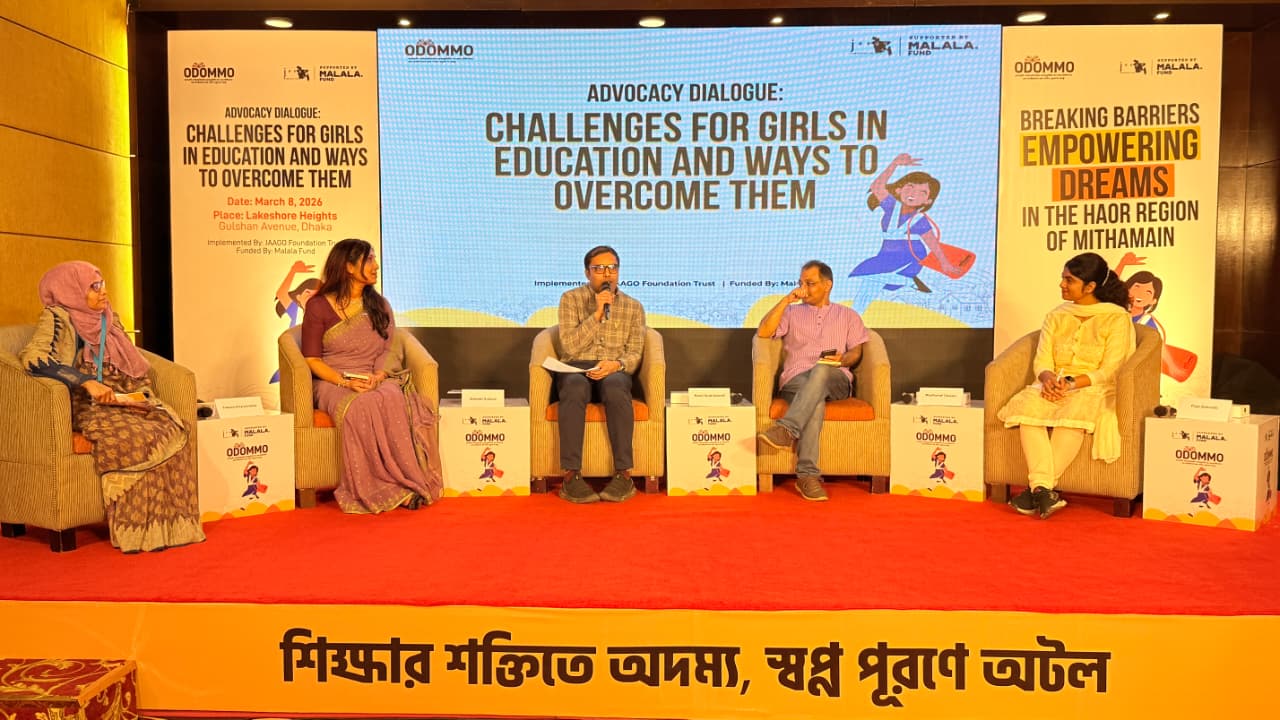

Experts and policymakers called for stronger policy measures and coordinated action to remove barriers to girls’ education at an advocacy dialogue held in the capital marking International Women’s Day.
The event was organised under the theme “Rights. Justice. Action. For all women and girls: Ensuring rights and protection for women and girls,” focusing on challenges faced by girls in climate-vulnerable regions, organisers said in a statement.


The dialogue was arranged under the “ODOMMO” project funded by Malala Fund and implemented by JAAGO Foundation Trust following the completion of the 40-month programme in Mithamain upazila of Kishoreganj, a haor region.
The programme brought together representatives from government agencies, civil society organisations, development partners, education experts, women leaders, private sector stakeholders and members of the Education Champion Network.
A panel discussion titled “Breaking barriers: Empowering girls to overcome educational discrimination in climate-vulnerable regions of Bangladesh” highlighted the risks faced by girls during climate-induced disasters.
UNICEF Bangladesh Child Protection Officer Fatema Khairunnahar said social and economic pressures during disasters often interrupt girls’ education, increasing risks of child marriage, child labour and school dropout.
“Community-based child protection mechanisms and coordinated social initiatives can help ensure girls’ education and safety in such contexts,” she said.
Independent Consultant and former Malala Fund country representative Mosharof Tansen said climate change is also a social justice issue that directly affects girls’ access to education.
He said stronger coordination among climate adaptation strategies, education policies and gender equality initiatives is necessary to address the challenge.
Plan International Bangladesh Director of Influencing, Campaigns and Communications Nishat Sultana said women and girls are often the first to face barriers during crises.
She said ensuring girls’ education in climate-vulnerable countries requires stronger policy focus, adequate budget allocation and long-term communication strategies to change social norms.
University of Dhaka student Puja Debnath said youth perspectives and field-level data should be incorporated into policy discussions to develop practical solutions.
Ministry of Women and Children Affairs Project Officer Halima Begum Prema said the work carried out through the ODOMMO project had created meaningful impact in the region.
“The initiative supported by Malala Fund demonstrates how coordinated efforts can address challenges to girls’ education,” she said.
Organisers said the project focused on identifying social, economic and environmental barriers affecting girls’ education in remote communities of Mithamain.
Over the past three years, 21 out of 23 planned project activities were completed, achieving around 91 per cent progress.
Awareness on preventing child marriage increased by 43.92 per cent, menstrual health awareness rose by 24.34 per cent and awareness on preventing gender-based violence increased by 22.75 per cent in project communities.
Girls’ school enrolment increased by nearly 20 per cent in the programme areas, while 88 per cent of families now prioritise girls’ education and 70 per cent of community members actively support girls’ participation in schooling.
At Haji Taiyeb Uddin High School in Mithamain, the dropout rate among girls has fallen to zero.
At Ghaghra Abdul Gani High School, the dropout rate among girls decreased by 61 per cent in 2025 compared with 2023, while more than 15 previously dropped-out students have returned to school.
JAAGO Foundation Trust Education Champion Kamrul Kibria Ayon said education remains the most powerful tool for social transformation.
“Our goal is to create an environment where every child, especially girls, can pursue their dreams without fear,” he said.
JAAGO Foundation Trust Senior Manager of Programme Implementation Iftikhar Ul Karim said the ODOMMO project helped raise awareness, promote safe learning environments and strengthen advocacy for education-friendly policies in remote areas.
Participants said ensuring safe, inclusive and quality education for girls is essential for building a just and equitable society and expressed hope that the experience of the ODOMMO project could serve as a model for broader social change in Bangladesh.
