

At 12:30pm, the school bell does not ring in the char lands of Gaibandha. There is no rush of children with bags on their backs, no morning assembly, no noise of recitation echoing through tin-and-brick classrooms.
Instead, silence sits heavy inside a four-room primary school in Fulchhari upazila.

Inside the office room of Endabari Dhalipata Dhoa Government Primary School, head teacher Laldlis Sultana sits with assistant teachers Marufa Akter and Nurjahan Laila, alongside night guard Mominur. They talk quietly as the clock moves past midday. Outside, not a single student is visible.

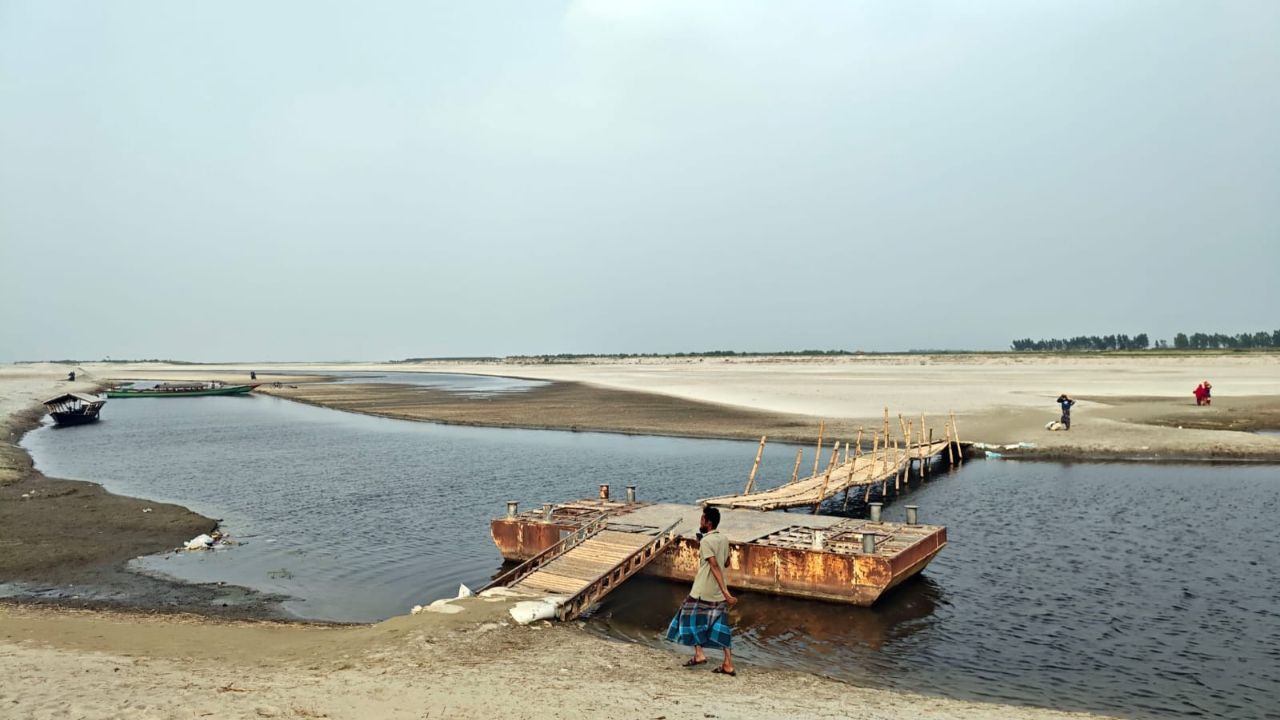
This is not an isolated moment. It is a picture of education across 165 riverine chars in Gaibandha, where the Brahmaputra, Jamuna and Teesta shape not only the land — but also the fate of schooling itself.

Primary education in these remote chars has slipped into crisis as government facilities struggle to function. Teacher shortages, irregular attendance and weak monitoring have left many schools barely running.

Locals say a large number of teacher posts remain vacant. Some appointed teachers rarely appear. Many stay absent for months and later sign attendance registers in bulk. Others, residents allege, assign classes to substitutes instead of teaching themselves.
As a result, children are slowly losing interest in school. In four upazilas, formal education has effectively collapsed across the char belts.
Teachers, however, describe another side of the crisis. Long and dangerous journeys across rivers and shifting sandbars during both dry and monsoon seasons create physical and mental strain. That hardship, they say, reduces their ability to remain consistent in classrooms.
Across the four char-heavy upazilas, there are 116 primary schools. Of these, 58 are in Fulchhari, 30 in Sundarganj, 15 in Gaibandha Sadar and 13 in Saghata. The schools have 472 teachers against 224 vacant posts. Around 2,915 students are enrolled from pre-primary to class five.
At Endabari Dhalipata Dhoa Government Primary School, the structure stands visible from a distance, but life inside does not match its name. It has four rooms, yet no active classroom scene at the time of visit.
After news of a media visit spreads, school staff rush to nearby homes to bring students. Within an hour, only four children arrive. The attendance register, however, lists 77 students from pre-primary to class five.
Shahinur Begum, a housewife in the area, describes a broken rhythm of schooling.
“If teachers do not come, will children go to school? Teachers come only 10 to 15 days a month. That is why I sent my children to the town for study,” she said.
Another resident, Rofiqul Islam, describes a cycle of absence.
“When teachers come, students do not come, and when students come, teachers do not come. This is how primary schools in the chars are running,” he said.
The head teacher offers a different perspective, pointing to geography and access.
“Is it possible to bring students from house to house? You know how much time it takes to travel from Gaibandha district town. We have two female teachers. Everyone faces the same problems. We all struggle to cross river sand and water,” she said.
In Gaibandha Sadar upazila, Chitulia Char Primary School presents another version of the same reality. The school has 40 students on record, but no teachers were present during a visit. A youth named Rahim was seen conducting classes in their absence.
Later, it is revealed that only one head teacher is posted there. He was at the upazila education office for official duties. Due to transport difficulties, teachers often avoid joining postings in the char schools. Some who do join leave within two months for other institutions.
Head teacher Abdur Razzak says the system is stretched beyond capacity.
“Please write about the teacher shortage. When I go to the upazila office for official work, I have to leave a student behind. If I do not, the school remains completely closed,” he said.
At Khelabari Government Primary School, children are present, but only two teachers are assigned. Locals say attendance is irregular. Teachers often spend time commuting instead of teaching.
At Lalchamar Char Bhati Burail Government Primary School in Sundarganj upazila, a visit at 11:30am finds no teacher on site. Locals say teachers appear only once or twice a month, and student attendance is almost nonexistent.
“We see teachers come and go at their own will. If we ask, they say the boat was late or they had work at the upazila office,” said resident Abu Hasan.
Officials acknowledge the challenge but also point to resource gaps.
Assistant Upazila Education Officer Abu Sufian says inspections are limited.
“Due to transport difficulties in the chars, it is not possible to inspect all schools,” he said.
He adds that manpower is also insufficient, with two officers working in place of six.
“We still try to monitor the schools facing problems,” he said.
District Primary Education Officer Lokhman Kumar Das says teacher reluctance remains a major issue.
Teachers avoid char postings, he says, and those who are posted often transfer elsewhere citing transport difficulties and other reasons.
He adds that action will be taken against teachers who intentionally skip school. He also believes community involvement can improve the situation.
“If local guardians and respected community members become more aware and supportive, teachers will not get the opportunity to skip classes. The quality of primary education will improve significantly,” he said.
In the chars of Gaibandha, classrooms exist on paper. But in reality, many of them drift between absence and uncertainty — carried away, like the land itself, by shifting rivers.
